
Use Zapier, n8n, or Make when the steps are the same every time and a non-developer needs to change them. Build your own code when runs pass a few thousand a month, the logic needs tests and version control, or the steps change from case to case. Most “AI agent” ideas for back-office work are really a fixed workflow with one model call in it, and that’s what we priced here.
We took one job, an invoice email that ends as an approved bill in QuickBooks, and priced it on all four options at 100, 1,000, and 10,000 runs a month. At 10,000 runs, Zapier’s Team plan lists $399 a month, n8n Pro €50, Make roughly $81, and our own code about $5 for hosting. The model tokens cost the same everywhere.
Who this is for: an owner or ops lead who has an automation idea with AI in it and is deciding whether to set it up in a no-code tool or pay for a build. Who should look elsewhere: if you only need two apps to sync with no AI step, any of the three tools will do and you don’t need this post.
The workflow we priced
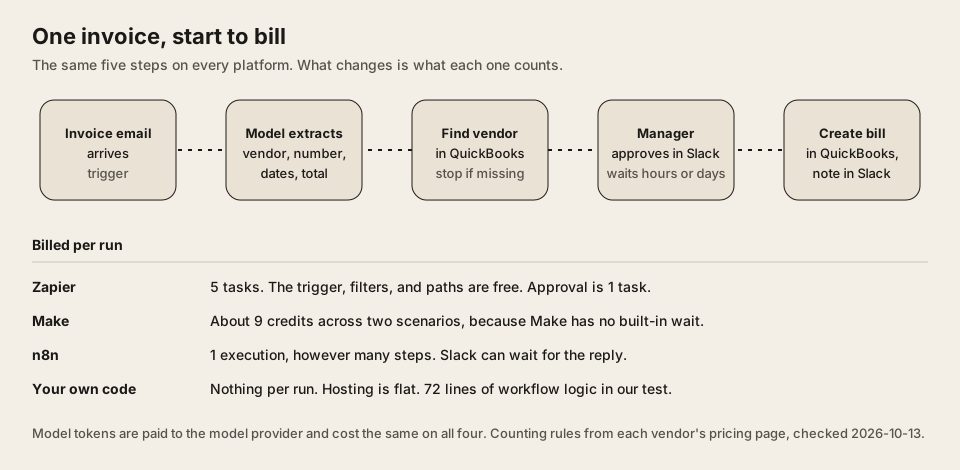
- An invoice email arrives.
- A model reads it and returns vendor, invoice number, dates, total, and currency as JSON.
- The vendor is looked up in QuickBooks. If it’s missing, a person is told.
- A manager approves or rejects in Slack. This can take days.
- On approval, a bill is created in QuickBooks and a note goes to Slack.
This is the job most “should I build an AI agent?” questions turn out to be. The model does one thing, reading a messy document. Everything else is fixed steps.
What each platform counts
The tools bill different units, so the same workflow costs a different number of units on each. All rules below are from each vendor’s pricing page, checked 2026-10-13.
- Zapier counts tasks. “A task is counted whenever Zapier successfully completes a unit of work for you.” Triggers, filters, paths, and formatter steps are free (Zapier pricing). Our flow uses 5 tasks: the AI step, find vendor, the approval, create bill, and the Slack note. Approval uses Zapier’s Human in the Loop, where “Only successful Human in the Loop actions will count toward your task usage” (Zapier help).
- Make counts credits. “Every time a module in a scenario performs an action, it consumes credits”, and the list includes “read data from an app or webhook”, so the trigger counts (Make pricing). Make has no built-in way to pause for days, so the flow splits into two scenarios joined by a data store and a Slack button webhook. We count about 9 credits per run.
- n8n counts executions. “An execution is a single run of your entire workflow. It doesn’t matter how many steps are in the workflow” (n8n pricing). Its Slack node can “Send and Wait for Response”, so the whole flow is 1 execution.
- Your own code counts nothing per run. You pay for hosting. Our version runs on Cloudflare Workers, where the Free plan allows “100,000 per day” requests and Paid starts at “$5 USD per month”.
Cost at 100, 1,000, and 10,000 runs a month
| Runs a month | Zapier Team (manager approves) | Zapier Professional (you approve yourself) | Make Core | n8n Cloud | Own code on Workers |
|---|---|---|---|---|---|
| Units used | 5 tasks a run | 5 tasks a run | about 9 credits a run | 1 execution a run | 2 requests a run |
| 100 | $69 (2,000 tasks) | $19.99 (750 tasks) | $9 (10,000 credits) | €20 Starter (2,500) | $0 |
| 1,000 | $119 (5,000 tasks) | $89 (5,000 tasks) | $9 (10,000 credits) | €20 Starter (2,500) | $0 |
| 10,000 | $399 (50,000 tasks) | $289 (50,000 tasks) | about $81 (90,000 credits) | €50 Pro (10,000) | $5 (Paid plan) |
Prices are monthly, billed yearly, checked 2026-10-13. Zapier monthly billing is about 50% more (Zapier pricing). n8n lists euro prices “billed annually” (n8n). Make shows Core at “$9 /mo” for 10,000 credits, or “$0.90 /1,000 credits”; the $81 at 90,000 credits uses that rate, and Make’s tier picker may show a different price at that size (Make). The code column is hosting only. KV storage writes on the Workers Free plan stop at “1,000 / day”, which is why we put the 10,000-run row on the $5 plan.
Three things the table hides:
- Who approves changes the Zapier plan. “If you’re on a Pro account, you can only send requests to yourself” (Zapier help). If a manager approves, you need Team, and “Reviewers must have a Zapier account.”
- n8n Cloud has a run-time cap. Starter allows 5 minutes per execution and Pro 40 minutes, per the n8n pricing page. n8n’s docs say a waiting workflow “offloads the execution data to the database” (Wait node docs), but they don’t say whether waiting time counts toward the cap. Test a two-day wait before you rely on it. Self-hosting n8n removes the cap and the fee, and adds a server to run.
- The build is not in the table. Setting up the no-code flow takes hours. The code version takes longer and needs a developer. At 100 runs a month, the build cost dwarfs every column.
The model cost is the same everywhere
All four can call the model with your own API key, so the token bill doesn’t depend on the platform. We assumed 1,500 input tokens (instructions plus a one-page invoice) and 150 output tokens of JSON per run. That’s our estimate, not a measurement.
| Runs a month | Claude Haiku 5.5 ($0.10 in, $0.50 out per 1M) | GPT-6.1 Sol ($2 in, $10 out per 1M) |
|---|---|---|
| 100 | $0.02 | $0.45 |
| 1,000 | $0.23 | $4.50 |
| 10,000 | $2.25 | $45 |
Prices from Anthropic and OpenAI, checked 2026-10-13. Zapier’s own “AI by Zapier” step is priced by model tier and “charged per AI step and per tool call”, so check its rates before you pick it over your own key.
The code version, measured
We wrote the code version in TypeScript with the Vercel AI SDK and ran it on 2026-10-13 against a fake model, a fake Slack, and a fake QuickBooks. What we measured:
- 72 lines of workflow logic, not counting blank lines and comments. Two functions: one handles the email, one handles the Slack button.
- It passed five checks: an invoice sent for approval, the same email skipped, the same invoice from a second email skipped, approval creating one bill, and a second click on the same button doing nothing.
- Not in the 72 lines: the HTTP routes, Slack request signing checks, QuickBooks OAuth token refresh, and turning a PDF into text. Each of those is real work, and a no-code tool gives you most of them for free.
The model step is the whole “AI” part:
const { output: inv } = await generateText({
  model: d.model,
  output: Output.object({ schema: Invoice }),
  prompt: `Extract the invoice fields. Use the exact numbers printed.\n\n${text}`,
});
What the code buys you that the 72 lines don’t show: duplicate checks you can unit test, every change in version control, and no per-step bill as volume grows. What it costs: a developer to change it, and hosting someone has to watch.
We didn’t build the n8n, Make, or Zapier versions for this post. Their per-run counts come from each vendor’s counting rules applied to the five steps above.
So when should you build an agent?
| Your situation | Pick |
|---|---|
| Under about 1,000 runs a month, steps never change, ops staff will edit it | n8n Cloud or Make. Zapier if your team already lives there |
| A manager must approve and you’re on Zapier | Zapier Team, or move the flow to n8n |
| Thousands of runs a month, or the cost grows with every step you add | n8n self-hosted or your own code |
| Logic that needs tests, code review, or touches money in ways you must audit | Your own code |
| The steps change from case to case, so the model has to choose tools | A real agent, in code, with an approval step before anything that spends money |
The last row is the only one that needs an agent in the strict sense, where the model picks which tools to call. For that, read how to make an AI agent wait for human approval and our notes on which AI SDKs we reach for. If you’re not sure the step needs a model at all, run our checklist for whether a feature should be AI first.
FAQ
Is n8n cheaper than Zapier?
For multi-step flows, usually yes, because n8n counts one execution per run and Zapier counts every action step. Our 5-step flow at 1,000 runs a month needs Zapier’s 5,000-task tier ($89 to $119) against n8n Starter at €20.
Can Zapier or n8n run an AI agent?
Both have agent features. Zapier Agents are billed in “activities, not tasks”, with a cap per run (Zapier pricing). n8n has an AI Agent node inside its workflows. They work well when the agent’s job is small and the tools it can call are already in the platform.
When does custom code become cheaper than Zapier?
On running cost alone, almost at once, because hosting is a few dollars. On total cost, only when the platform bill over a year or two is bigger than the build. For our flow, that’s somewhere in the thousands of runs a month on Zapier, and later on n8n or Make.
Do I need a developer for n8n?
Not for a flow like this on n8n Cloud. You do for self-hosting, where someone has to keep the server patched and backed up.
Is an AI workflow the same as an AI agent?
No. A workflow runs fixed steps and may call a model for one of them. An agent lets the model decide which steps to take. Most back-office jobs are workflows, and they’re cheaper and easier to trust.
Dawloom builds AI agents and AI integrations in code when the volume or the logic calls for it, from a written scope, billed hourly or by milestone. For the token side of the bill, try the AI feature cost calculator.