
A small business abroad can hire a Pakistan-based team to build an AI app, and the Clutch Pakistan AI directory is the quickest place to find firms with public reviews and a stated minimum budget. The right team shows you a working build like yours, puts the code, API keys, and accounts in your name, and prices each milestone from a written scope.
This guide doesn’t rank companies. Our list of Pakistan software companies for small projects does that. This one helps you decide what to build, what it will cost to run, and how to work with a team five to ten hours ahead of you.
Who this is for: a shop, clinic, agency, distributor, or online store in the US, UK, EU, Australia, or the Gulf, with roughly 2 to 50 staff, that wants AI to answer customers, read paperwork, or help with orders, and is looking at Pakistan to keep the build cost down. Who should pick something else: if you only want auto replies to common questions, a monthly chatbot tool is cheaper than any custom build. If you’re a bank, insurer, or large group with a compliance team, go to a large firm with enterprise references and audits.
What small businesses actually build
Most small-business AI projects fall into three shapes. Pick the one that matches the first job you want done.
- A chatbot that answers customers. It runs on WhatsApp or your website and replies in your customers’ languages. It reads your price list, delivery areas, and FAQ. A good one hands the chat to a person when it isn’t sure.
- A document reader. It reads invoices, receipts, delivery slips, or forms, and puts the fields into a sheet or your accounting system. A person checks the rows the model is unsure about.
- An order or inventory assistant. It checks stock, drafts orders, or updates records in your systems. This is an AI agent, and it should ask a person before it does anything with money or stock. Our guide to AI agent companies for small businesses covers this shape in more depth.
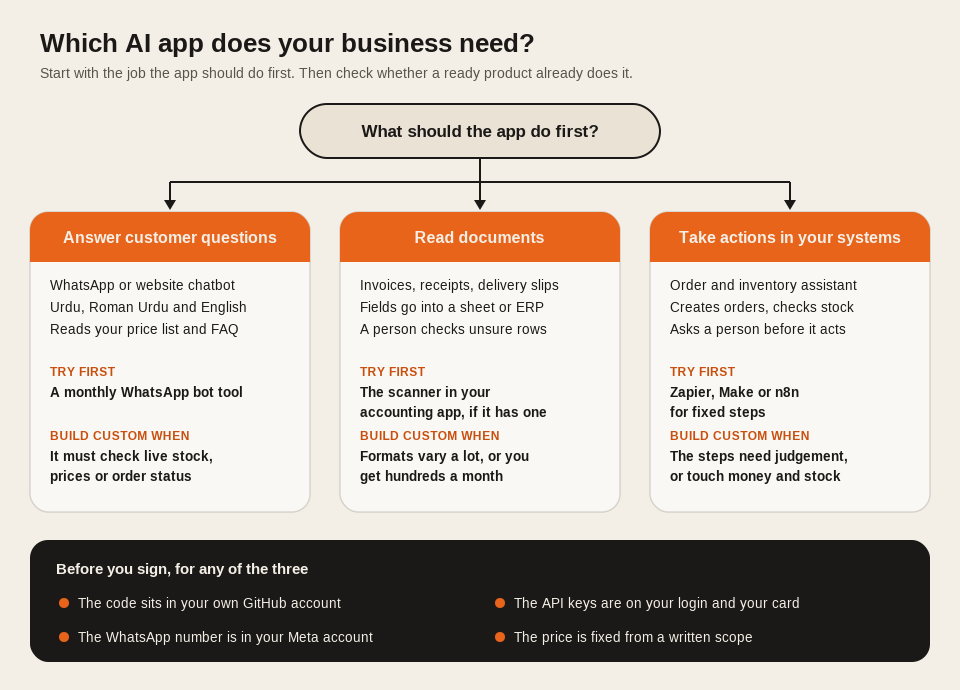
Before you hire anyone, ask whether the job needs AI at all. A fixed rule or a form is often cheaper and more reliable. We use this checklist on our own projects.
What drives the cost
There are two bills: building the app once, and running it every month. Many quotes only show the first.
Scope and the team’s rate
Scope is the biggest driver. The second is the team’s rate. On the Clutch Pakistan AI directory, minimum project sizes on the first page ran from $1,000+ to $50,000+ when we checked on 2026-10-17. Ask every firm for a quote in your currency, split into milestones, with each integration as its own line.
Most of the gap between a cheap quote and an expensive one is a scripted bot versus one that uses a language model and connects to your systems. Ask any vendor which model the bot uses. If they can’t name one, it’s scripted. That’s fine for simple FAQs, but it isn’t an AI app.
Model API usage, priced per token
An AI app pays the model provider per token (a small chunk of text). Three price points from the official pages, standard tier, per million tokens, checked 2026-10-17:
| Model | Input | Output | Source |
|---|---|---|---|
| Google Gemini 2.5 Flash-Lite | $0.10 | $0.40 | Gemini API pricing |
| OpenAI gpt-5-mini | $0.25 | $2.00 | OpenAI API pricing |
| OpenAI gpt-6-astra (flagship) | $10.00 | $50.00 | OpenAI API pricing |
A worked example, our calculation: a WhatsApp bot handles 3,000 conversations a month. Each has 6 back-and-forth turns. Each turn sends about 1,500 tokens in (your instructions, the FAQ, and the chat so far) and gets about 150 tokens back. That’s 27 million input tokens and 2.7 million output tokens a month.
| Model | Monthly model bill |
|---|---|
| Gemini 2.5 Flash-Lite | about $3.78 |
| gpt-5-mini | about $12.15 |
| gpt-6-astra | about $405 |
Model choice moves the bill more than 100 times. A small model is usually enough for FAQ answers, so test one on your real questions first. This bill is the same wherever the team sits, because you pay the model provider directly. To run your own numbers, try our AI feature cost calculator, or read how much GPT or Claude costs per user.
WhatsApp fees
If the bot runs on the official WhatsApp Business Platform, Meta charges per template message, by category and by your customer’s country code, not the developer’s. Meta’s pricing page says “All non-template messages are free” and that a customer’s message “opens a 24 hour customer service window.” So replies to customers who message you are free inside that window. Broadcasts and templates sent after it closes are charged at each customer’s country rate. Ask whether the quote includes Meta’s fees.
Integrations, hosting, and upkeep
Each system the app talks to is its own piece of work: your POS, accounting software, Google Sheets, a Shopify store, or a booking system. A bot that checks live stock needs an integration, and your POS must allow one. A custom app also needs a server, and someone must update the prompts when your prices change. Get the monthly hosting bill and the support price after the free period in writing.
Working with a team in Pakistan
Time zones
Pakistan Standard Time is UTC+5, and Pakistan doesn’t change its clocks in summer. So the gap to you changes with your own daylight saving:
| You are in | Pakistan is ahead by |
|---|---|
| UK | 5 hours in winter, 4 in summer |
| Germany, France, most of the EU | 4 hours in winter, 3 in summer |
| US East Coast | 10 hours in winter, 9 in summer |
| US West Coast | 13 hours in winter, 12 in summer |
| UAE | 1 hour |
For the UK and EU, a team’s afternoon is your morning, so a daily call is easy. For the US, agree on one fixed overlap hour, often your early morning and the team’s evening. Ask each firm which hours its developers actually work, and get it in writing.
Your customers’ data
If you’re in the EU, sending customer data to a team in Pakistan is a transfer outside the EU. Pakistan isn’t on the European Commission’s list of countries with an adequacy decision, so you need another legal basis, usually standard contractual clauses in the contract. The UK has its own version, the International Data Transfer Agreement. Two simpler steps cut the risk for any buyer:
- Keep production data on your own accounts and give the team test data while it builds.
- Ask which model provider receives the messages and whether chats are stored, then check that provider’s data terms yourself.
Paying safely
Pay per milestone, after you’ve seen each one work. Use a channel with a paper trail, such as a bank transfer against an invoice. If you hire through a marketplace like Upwork, its milestone payments are held until you approve the work. Never pay the whole project up front.
How to choose and vet a team
Questions to ask
- Can I try a live AI app you built that is like mine? A link or a test number, not slides.
- Which model does it use, and why? A good answer names the model and the cost and quality trade-off.
- What will it cost per month at my volume? Model bill, Meta’s fees, and hosting as separate lines.
- Can I test it on my real customer messages before the final payment? Agree on 20 or 30 real questions, in every language your customers use.
- What happens when the bot doesn’t know? It should hand over to a person.
- Where does my customer data go? Which provider receives the messages, and are chats stored?
- Who exactly will build it, and in which hours? Names, and the overlap with your working day.
- How is each milestone priced, and what does a change cost?
Who owns the code and the keys
Settle this in writing before you pay anything:
- Code in a GitHub or GitLab account that you own, with the team added as members.
- API keys for OpenAI, Google, or Anthropic created on your own account, billed to your card. If the keys sit on the vendor’s account, they control your app and see your bill.
- WhatsApp number and Meta Business account in your company’s name.
- Domain and hosting in your name, or a written handover plan.
Our post on who owns the code when you hire an agency covers the contract clauses.
Red flags
- A quote before anyone asked how you work today.
- No monthly running cost in the proposal.
- “Our AI never makes mistakes”, or the bot is allowed to act with no person checking.
- The vendor wants the API keys or the WhatsApp number on its own account.
- Prompts described as the vendor’s secret, so you can’t read or change them.
- No named people, or no fixed hours that overlap with yours.
Milestones or hourly
| Priced milestones from a written scope | Hourly | |
|---|---|---|
| Best when | The job is clear: one bot, one channel, named integrations | You’re still exploring what the app should do |
| Your risk | Changes cost extra, so write the scope carefully | The bill grows if the work drags |
| Ask for | A scope listing every screen, integration, and test | A weekly cap and a weekly report |
For a first small AI app, one priced milestone is usually the safer start. Our general guide to vetting an offshore team covers trial tasks and payment terms.
Where to find vetted teams
- Clutch. The Pakistan AI directory and its chatbot section show each firm’s minimum project size and hourly band. Look for reviews from clients in your own country that mention AI or chatbot work, and check the office city, since some listed firms are based abroad.
- PSEB. IT companies that export software register with the Pakistan Software Export Board through techdestination.com. We found no public lookup there, so ask for the certificate. It proves the firm is registered. It says nothing about the quality of its work.
- SECP. For a registered company, check the name on the SECP company name search.
- P@SHA. The Pakistan IT industry association has a Members Directory page, but on 2026-10-17 it said “Coming Soon!” and listed no companies. Until it goes live, ask for proof of membership.
Then read reviews on a platform the company can’t edit, and start with one small paid milestone.
Where Dawloom fits
We’re Dawloom, a team of about ten in Pakistan that builds for clients abroad. We wrote this guide, so weigh that. We build AI features and AI agents from a written scope, billed at $30 an hour or milestone by milestone.
We have no client AI app we can name yet. Our public AI work is our MCP server at dawloom.com/mcp and our free tools, which you can try yourself. Our reviews, 4.9 from 343 on Fiverr and 5.0 from 156 on Freelancer.com, are for past orders and none of them is for a client AI app we can name. See them on our reviews page.
Pick a larger firm if you need a team of 20 or more, enterprise references, a compliance audit, or someone on site in your city. Pick a monthly chatbot tool if you only need FAQ replies.
FAQ
Is it cheaper to build an AI app with a team in Pakistan?
Usually the build is cheaper, because rates are lower. The running cost is not. You pay the model provider, Meta, and your hosting at the same prices wherever the team sits. Compare quotes on the full first-year cost: the build, a year of running costs, and support after the free period.
How do I manage the time difference?
Pakistan is UTC+5 all year. From the UK or EU the team is 3 to 5 hours ahead, so your morning is their afternoon. From the US it’s 9 to 13 hours, so agree on one fixed overlap hour a day and a written update at the end of the team’s day.
Is my customer data safe with an offshore team?
It depends on the setup more than the country. Keep production data and API keys on your own accounts, give the team test data, and put the data rules in the contract. If you’re in the EU, you need standard contractual clauses, because Pakistan has no EU adequacy decision.
Should I use a ready-made tool or hire a team?
Use a ready-made tool if the bot only answers fixed questions from a price list or FAQ. Monthly chatbot tools are cheaper and faster to start. Hire a team when the app must check live stock, read your documents, or act in your systems. That needs integrations and testing that a monthly tool doesn’t do.
Who should own the OpenAI or Gemini API key?
You should. Create the key on your own account, billed to your card, and give the developer access. Then you control the app, see the real bill, and can switch vendors without rebuilding. A vendor who refuses this and wants to keep the key on its own account is a red flag.
If you want a second opinion on a quote, or a written scope for your own AI app, tell us what you’re building.