
A typical AI feature costs between about 1 cent and $5 per active user per month in model tokens, at prices we checked on 2026-10-13. On a mid-priced model such as Claude Sonnet 5.5 or GPT-6.1 Sol, our four example features land between $0.26 and $1.07 per user per month, and the two things that move the bill most are what the feature does (a chat or an agent re-sends its whole history on every call) and whether prompt caching is on.
The calculator below works it out for your feature. Pick summarise, extract, chat, or agent, set the size in words, the number of users, and the model. It runs in your browser and sends nothing anywhere.
Who this is for: founders and product owners who want to add a model-powered feature to an app and need a per-user number before they build it. Who should look elsewhere: if you already charge a seat price and want a full gross margin with Stripe fees and hosting, use our AI SaaS margin calculator. If you pay for ChatGPT or Claude seats for your staff, you need the Claude or ChatGPT plan pages, not API prices.
Result on Claude Sonnet 5.5
Per conversation
$0.0290
Per user / month
$0.58
Heavy user / month
$2.90
Bill for 1,000 users
$579.52
Model cost is 2.9% of the price for a typical user and 14.5% for a heavy one.
Tokens per conversation: 329 fresh input, 24,041 read from cache, 2,045 written to cache, 2,080 output.
Prompt size at each turn. The whole history is sent again every time. Dark is read from cache.
The same conversation on every model, cheapest first
| Model | Per conversation | Per user / month | Share of price | Bill for all users |
|---|---|---|---|---|
| $0.0012 | $0.0241 | 0.1% | $24.14 | |
| $0.0016 | $0.0314 | 0.2% | $31.38 | |
| $0.0027 | $0.0547 | 0.3% | $54.68 | |
| $0.0075 | $0.15 | 0.7% | $149.60 | |
| $0.0100 | $0.20 | 1.0% | $199.14 | |
| $0.0101 | $0.20 | 1.0% | $201.92 | |
| $0.0212 | $0.42 | 2.1% | $424.80 | |
| $0.0223 | $0.45 | 2.2% | $445.79 | |
| $0.0273 | $0.55 | 2.7% | $546.77 | |
| $0.0290 | $0.58 | 2.9% | $579.52 | |
| $0.0362 | $0.72 | 3.6% | $724.16 | |
| $0.0425 | $0.85 | 4.2% | $849.60 | |
| $0.0483 | $0.97 | 4.8% | $965.55 | |
| $0.0566 | $1.13 | 5.7% | $1,132.80 | |
| $0.0580 | $1.16 | 5.8% | $1,159.05 | |
| $0.0598 | $1.20 | 6.0% | $1,196.80 | |
| $0.11 | $2.27 | 11.3% | $2,265.60 | |
| $0.12 | $2.41 | 12.1% | $2,413.87 | |
| $0.14 | $2.78 | 13.9% | $2,777.41 |
Caching assumes the shared instructions are already warm from other users and each turn follows the last within the cache lifetime. Prompts shorter than the provider's minimum are not cached: 512 tokens on Claude 5.5 models, 1,024 on OpenAI, 4,096 on Gemini. Model cost only. Hosting, Stripe fees, retries, and web search calls are extra.
The same calculator lives on its own page at /tools/ai-feature-cost-calculator/.
How much does an AI feature cost per user?
These are the calculator’s starting values on seven models, with prompt caching on and no Batch API. The inputs are our examples of a small product, not measurements from a client app. Change them to your own.
- Summarise: a 2,000-word document in, a 200-word summary out, 30 a month per user.
- Extract: instructions plus a JSON schema, an 800-word invoice or form, 150 words of JSON out, 100 a month.
- Chat: a 1,200-word system prompt, 8 turns per conversation, 40-word questions, 150-word answers, 20 conversations a month.
- Agent: instructions plus 10 tool definitions (2,500 words), 6 model calls per task, 100 words out and a 500-word tool result per call, 40 tasks a month.
| Feature, per user per month | Claude Opus 5.5 | Claude Sonnet 5.5 | Claude Haiku 5.5 | GPT-6.1 Sol | GPT-5.4 mini | Gemini 3.8 Flash | Gemini 3.1 Flash-Lite |
|---|---|---|---|---|---|---|---|
| Summarise | $0.63 | $0.31 | $0.016 | $0.26 | $0.11 | $0.10 | $0.035 |
| Extract | $1.10 | $0.55 | $0.028 | $0.57 | $0.23 | $0.22 | $0.077 |
| Chat | $1.16 | $0.58 | $0.031 | $0.45 | $0.20 | $0.42 | $0.15 |
| Agent | $2.15 | $1.07 | $0.061 | $0.83 | $0.35 | $0.51 | $0.18 |
Prices are the standard tier from the official pages of Anthropic, OpenAI, and Google, checked 2026-10-13. The most expensive model in our price file, GPT-6 Astra at $10 in and $50 out per million tokens, runs the same agent for $4.70 per user per month. That’s the top of the range in the first line.
So for 1,000 active users, a chat feature on Claude Sonnet 5.5 is a model bill of about $580 a month. The same feature on Claude Haiku 5.5 is about $31. Whether the small model is good enough for your users is a question to test. Our guide to the AI SDKs we reach for covers how to switch models without rewriting the feature.
Why chats and agents cost more than they look
A model API doesn’t remember the last message. Your app sends the whole conversation again on every turn. Turn 8 of a chat pays for turns 1 to 7 as input, and step 6 of an agent pays for every tool result from steps 1 to 5.
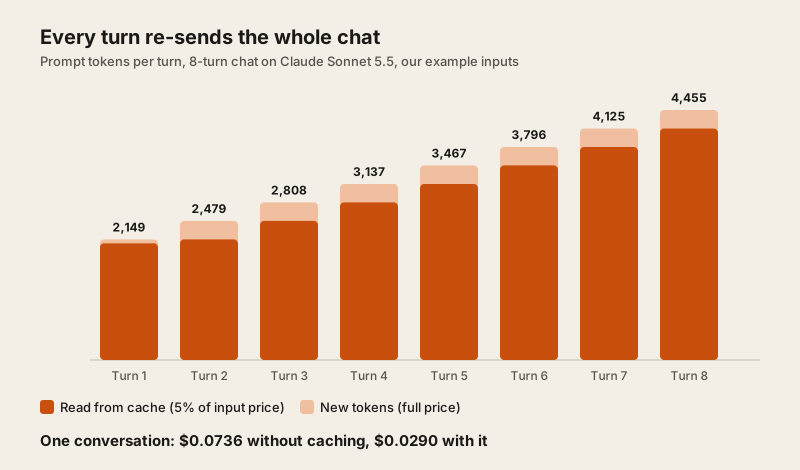
In our chat example the prompt grows from 2,149 tokens at turn 1 to 4,455 at turn 8. Across the conversation that’s about 26,400 input tokens to produce about 2,100 tokens of answers. Input is about 13 times the output, so the input price matters more than the headline output price suggests.
Prompt caching fixes most of this. The provider keeps the start of your prompt for a few minutes and bills it at a small share of the input price when you send it again. On Claude Sonnet 5.5 and Opus 5.5, Anthropic’s page says “a cache hit costs 5% of the standard input price”. Here’s what that does on Sonnet 5.5:
| Feature, per user per month | No caching | Caching on | Caching and Batch API |
|---|---|---|---|
| Summarise | $0.34 | $0.31 | $0.16 |
| Extract | $0.75 | $0.55 | $0.27 |
| Chat | $1.47 | $0.58 | not suitable |
| Agent | $3.79 | $1.07 | not suitable |
Caching cuts the chat by 61% and the agent by 72%. It barely moves the summary, because each document is new and only the 300-word instructions repeat.
Three caching rules change the result, and most calculators skip them:
- There’s a minimum. A prefix shorter than the provider’s minimum isn’t cached at all. Anthropic’s minimum is 512 tokens on the Claude 5.5 models and 1,024 on Sonnet 4.6 (docs). OpenAI’s is “1,024 tokens for GPT-5.6 and later” (docs). Google lists 4,096 for Gemini 3.1 Pro and 3.8 Flash (docs).
- The cache expires. Anthropic’s default is “a 5-minute lifetime”, refreshed each time it’s read. OpenAI says a prefix on GPT-5.6 and later “remains eligible for reuse for 30 minutes after its most recent write or reuse”. A user who answers after a long pause pays full price for the history again.
- Writing can cost extra. Anthropic bills a 5-minute cache write at 1.25x the input price. The calculator only writes to the cache when a later call will read it.
The minimum is why Gemini looks worse for chat here than its list price suggests. Our chat prompts never reach 4,096 tokens on Google’s count, so nothing is cached. Gemini 3.1 Pro has the same $2 input price as GPT-6.1 Sol, but the chat costs $1.20 per user on Gemini 3.1 Pro and $0.45 on GPT-6.1 Sol. With a longer system prompt, the gap closes. Google also offers explicit caches, which bill storage by the hour; the calculator doesn’t model those.
When the Batch API halves the bill
All three providers sell a Batch API at half the standard price. You send requests in bulk and collect the results later. OpenAI says each batch “completes within 24 hours (and often more quickly)” (guide). Anthropic says most batches finish “in less than 1 hour” and that cache discounts “stack with other pricing modifiers, including the Batch API discount” (pricing). Google’s page labels it “Batch API (50% cost reduction)” but keeps Gemini 3.1 Pro’s batch cache price the same as standard.
Batch suits work nobody is waiting for: overnight summaries, a backlog of invoices, re-tagging a product catalogue. It doesn’t suit chat or agents, so the calculator turns it off for those.
Heavy users decide your margin
Averages hide the people who use a feature all day. The calculator has a heavy-user setting, five times the typical usage by default. On Claude Sonnet 5.5, a typical agent user costs $1.07 a month, 5.4% of a $20 seat. A heavy one costs $5.37, which is 26.8%. On Claude Opus 5.5 the heavy agent user costs $10.73, more than half the seat.
The calculator warns when a typical user passes your line (20% of the price by default) and separately when a heavy user does. The fix is usually an allowance with metering above it. Our post on how to price an AI SaaS works through that with Stripe fees included, and usage-based billing for AI compares the tools that meter it.
Four things that make the real bill different
- Tokenizers differ. Anthropic’s page says Claude 4.7 and later use a tokenizer that “produces approximately 30% more tokens for the same text”. The calculator adds that 30% to the newer Claude models. Two models with the same price per token can bill different amounts for the same words.
- Thinking is output. Reasoning tokens are billed at the output price. If your agent thinks for 1,000 words before each tool call, put that in the output field. On these models output costs five to six times the input.
- Words are an estimate. OpenAI’s key concepts page says “1 token is approximately 4 characters or 0.75 words for English text.” Code, tables, JSON, and other languages use more tokens per word.
- Tools can cost money. Web search costs $10 per 1,000 searches on Claude and OpenAI, plus the result tokens. Google’s search grounding is free for the first 5,000 requests a month, then $14 per 1,000 (Google pricing). An agent that searches on every task adds a cent or more per task. Tool definitions add tokens to every call, which we measured in why MCP servers use so many tokens.
How to get your own numbers
Run the feature on 20 to 50 real inputs before launch and log the usage object every response returns. Anthropic reports input_tokens, cache_read_input_tokens, cache_creation_input_tokens, and output_tokens. OpenAI reports input and output tokens, with cached tokens in the input details. Average them, then look at your 90th percentile input, because that’s your heavy user. Divide those token counts by 1.33 to get words (and by another 1.3 on newer Claude models), put them in the calculator, and you have a cost per user you can defend.
Before you do any of this, check that the feature needs a model at all. Our checklist, should this feature be AI, catches the cases where plain code is cheaper and more reliable.
What other calculators leave out
We read the calculators that rank for this question before building ours. CostGoat’s Claude calculator, for example, takes tokens per call and calls per month, with on and off switches for batch and caching. It has no user count, no cache minimum, and a fixed prompt size per call, so it can’t show a chat getting more expensive turn by turn. Ours starts from the feature, works per user, compares all 13 models in our price file at once, and shows the two Gemini 3.8 Flash prices: Google lists $0.75 input “through December 31, 2026” and $1.50 “starting January 1, 2027”. Our chat example on Gemini 3.8 Flash goes from $0.42 to $0.85 per user that day.
If you want a team to build the product or the agent, see our AI SaaS development and AI agent development services.
FAQ
How much does it cost to add ChatGPT to my app per user?
On the OpenAI API, our chat example costs $0.45 per user per month on GPT-6.1 Sol and $0.20 on GPT-5.4 mini, with caching on, at prices checked 2026-10-13. That’s 20 conversations of 8 turns each. The API bills per token, separate from any ChatGPT subscription.
Is Claude more expensive than GPT per user?
At the same list price, Claude can cost a little more, because the newer Claude tokenizer produces about 30% more tokens for the same text. Claude Sonnet 5.5 and GPT-6.1 Sol both list $2 input and $10 output per million tokens. Our chat example costs $0.58 per user on Sonnet 5.5 and $0.45 on GPT-6.1 Sol. Measure both on your own prompts before you decide.
How do I reduce my LLM cost per user?
In order of effect for chat and agents: turn on prompt caching and keep the start of every prompt the same, send easy requests to a small model, trim old turns or summarise them, and cap heavy users with an allowance. For work nobody waits for, use the Batch API at half price.
What is a safe share of the price to spend on model tokens?
There’s no standard number. Our default warning is 20% of what the user pays, which leaves room for Stripe, hosting, and support. Bessemer’s State of AI 2025 report found its steadier fast-growing AI startups averaged about 60% gross margin, so tokens plus everything else had to fit in the other 40%.
How often do these prices change?
Often enough to check every quarter. The tool shows the date we last checked each price. Google has already announced that Gemini 3.8 Flash doubles in price on January 1, 2027.
If you want a model-powered feature added to an app that already has users, with caching, model routing, and usage caps built in from the start, see our AI integration work or tell us what you’re building.