
Use Lovable or Bolt to get a working demo in front of users for about $25 a month. Bring in a developer, either to review the code or to rebuild it, before the app stores real user data, takes payments, or grows past a few hundred users. Hire an agency from the start only if you already know what to build and have the budget for it.
At 1,000 users the hosting bill barely changes between the two routes. Model tokens and Stripe fees cost the same either way. The real differences are what you pay up front, who is responsible for security, and how hard the app is to change later.
Who this is for: a founder deciding how to build the first version of an AI SaaS product. Who should look elsewhere: if your Lovable or Bolt app already exists and is breaking, read what a rescue costs instead.
What we did for this post. We did not build the same app twice for this comparison. We read the official pricing pages and docs for Lovable and Bolt on 2026-10-13, the public security research on apps built with them, and the pricing pages for the services a hand-built app uses. Every number below links to its source and says who measured it.
Lovable vs Bolt vs an agency at a glance
| Lovable | Bolt | Freelancer or agency | |
|---|---|---|---|
| Up-front cost | $0 to start | $0 to start | A fixed price or hourly. AI MVPs on our list of AI SaaS development agencies start around $7,500 to $25,000 |
| Monthly cost to keep building | Pro from $25 a month for 100 credits | Pro $25 a month, “Start at 10M tokens per month” | Retainer, or nothing between projects |
| Time to a first demo | Hours | Hours | Weeks |
| Stack | TanStack Start and Postgres for new apps. “Lovable does not offer a choice of framework or database” | Bolt’s own hosting, “Choice of database provider” on Pro | Whatever fits the product |
| Who checks security | You. Lovable’s docs say “You are responsible” | You | The developer, if it’s in the scope. Ask |
| Getting the code out | Git sync on every plan. Zip download on paid plans | Zip download and GitHub sync | The repository should be yours from day one |
Sources: Lovable plans, Lovable FAQ, Lovable security docs, and Bolt pricing, all checked 2026-10-13.
What Lovable and Bolt cost
Lovable sells credits. Pro starts at $25 a month for 100 credits and goes up to $2,250 a month for 10,000. Business starts at $50 for 100 credits. Extra credits on Pro cost “$15 per 50 credits.” Every plan also gets 5 free build credits a day. Lovable’s pricing page gives example costs per message: changing a button color is 0.50 credits, adding authentication 1.20, and building a landing page 1.70. Checked 2026-10-13.
Hosting comes out of the same credits. Lovable’s credits docs say hosting is charged by database size, storage, network, and compute, but give no price per unit. Its pricing page says that for smaller apps hosting is “minimal and fully covered by the included grant.” If credits run out, “Your published site stays live,” but backend services “pause shortly after you run out of credits.” Watch that last line. A paused backend means your users can’t log in.
Bolt sells tokens. The pricing page lists Free at $0 with “1M tokens per month,” Pro at $25 a month starting at 10 million tokens, and Teams at $30 per member. Bolt also warns that “the larger the project, the more tokens used per message.” So the same change costs more as the app grows. Checked 2026-10-13.
Both are cheap compared with hiring anyone. The cost that’s harder to see is the fix loop: asking the AI to fix a bug, which breaks something else, which you ask it to fix again. Every round uses credits or tokens.
What it costs to run at 1,000 users
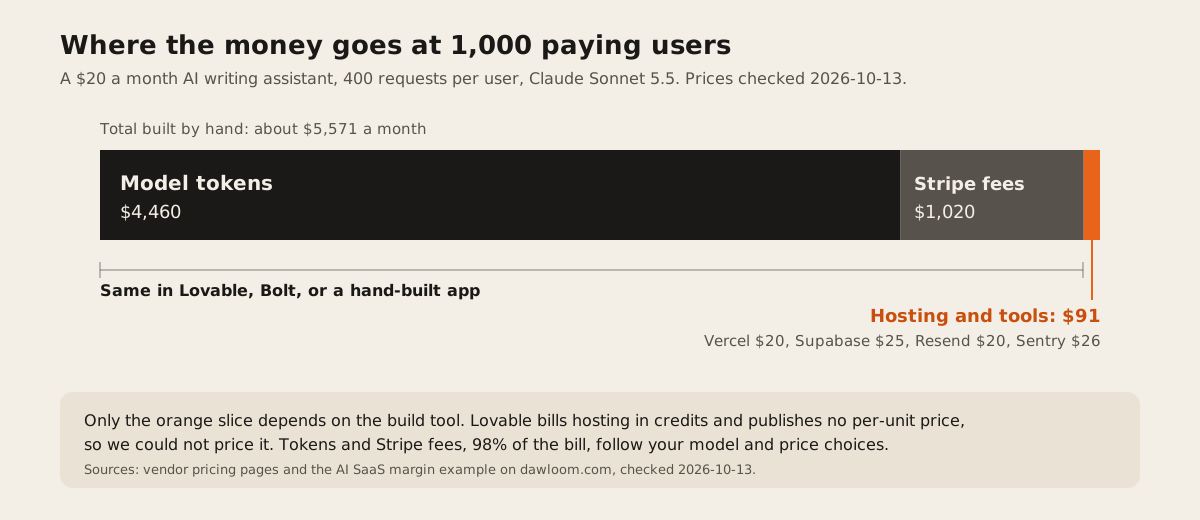
Take the $20-a-month writing assistant from our AI SaaS pricing guide: 400 requests per user per month on Claude Sonnet 5.5. At 1,000 paying users, here is the monthly bill. Prices checked 2026-10-13.
| Line | Built by hand | Built in Lovable |
|---|---|---|
| Model tokens | $4,460 | $4,460. The same model costs the same |
| Stripe card and Billing fees | $1,020 | $1,020 |
| Hosting | Vercel Pro $20 | Lovable Cloud, paid in credits. No per-unit price published |
| Database and file storage | Supabase Pro $25 | Included in Lovable Cloud credits |
| Login | Clerk $0 up to 50,000 monthly retained users, or Supabase Auth | Included |
| Resend Pro $20 for 50,000 emails | Not priced separately in the docs we read | |
| Error tracking | Sentry Team $26 | Not included. Add your own |
| Building more features | Developer time | Lovable plan, from $25 |
| Total | about $5,571 | about $5,505, plus Cloud usage |
What the table shows:
- Tokens and Stripe are 98% of the bill either way. The tool you build with doesn’t change them. Model choice, caching, and usage limits do. Our guide on how to price an AI SaaS covers those.
- The platform slice is about $91 a month built by hand. Lovable’s version of that slice is paid in credits, and we couldn’t price it from public docs. At this size, the difference is small either way.
- The real gap is up front. A first version costs tens of dollars in Lovable and thousands from a developer. The money question is whether the cheap version holds once real users and real payments arrive.
What goes wrong, by the numbers
Here are the public numbers on apps built with AI builders such as Lovable and Bolt. Each one says who measured it.
- 1 in 10 Lovable apps in one scan exposed data. Security researcher Matt Palmer scanned 1,645 Lovable projects and found “303 endpoints across 170 projects (approximately 10.3% of the 1645 analyzed)” where the database could be read without logging in. The exposed data included names, phone numbers, payment details, and API keys. The issue is recorded as CVE-2025-48757, rated 9.3 of 10. Lovable disputes it, on the grounds that “each individual customer of the Lovable platform accepts a responsibility over protecting the data of their application.” Measured by an independent researcher, in early 2025.
- 2,000+ vulnerabilities across 5,600 apps. Security firm Escape scanned over 5,600 public apps built on Lovable, Bolt, Base44, and others. It found “more than 2,000 vulnerabilities,” “400+ exposed secrets,” and 175 cases of exposed personal data. Escape sells security testing. It calls its numbers “lower-bound estimates,” and says the sample is “heavily skewed toward Lovable deployments.” Published October 2025.
- A login bypass on a whole platform. Wiz Research found that private apps on Base44 could be joined with only a public app ID. Wix fixed it within 24 hours. This was a platform bug, not a user mistake, which is a different risk: you can’t fix it yourself.
- 45% of AI-written code samples failed a security check. Veracode tested over 100 models on 80 coding tasks and found insecure choices in 45% of cases. Veracode sells code scanning. The number is per code sample, not per app.
The common thread is access rules. Lovable and Bolt apps often talk to the database straight from the browser, with a public key. That design is safe only if every table has row-level security policies that limit each row to its owner. We show the one-line test for this in what a Lovable or Bolt rescue costs.
Lovable has added scanners since 2025. Its security docs describe a Quick scan on every publish and a deeper code scan you start by hand. The same docs say: “These tools help identify common security issues, but they cannot guarantee complete security.” For apps with sensitive data, they suggest “an additional professional security review.”
Why the data model decides the cost of later changes
An AI builder like Lovable or Bolt adds a table each time a prompt needs one. Ten prompts later you can have three tables that mean “customer.” That works for a demo. It hurts when you add billing, reports, or a second kind of user, because each change has to touch the duplicates.
A developer starts from the data model: which tables exist, who owns each row, and which fields must never be empty. For a SaaS with several customers sharing one database, that includes how tenants are kept apart. It takes longer up front. It’s the part that decides how cheap the next 50 changes are.
Lovable’s FAQ adds a hard limit: “You cannot connect an existing repository or start a project from one.” So the usual path is one way. You start in Lovable, sync to GitHub, and continue outside Lovable if you need to. The database export “does not include stored files, Edge Function code, or secrets,” so plan that move before you need it.
Lovable, Bolt, or an agency: which to pick
| Your situation | Pick |
|---|---|
| You want to know if anyone will use the idea | Lovable or Bolt. Spend $25 to $100, not $25,000 |
| You need a clickable demo for investors | Lovable or Bolt |
| The demo works and people want to pay | Keep the demo, and pay a developer to review access rules, payments, and secrets before launch |
| The app will hold health, money, or children’s data | A developer from the first real user. Treat the builder version as a spec |
| You already know the product, and have a budget | An agency or freelancer with a fixed price. See the best AI SaaS development agencies |
| The app is live and breaking | A rescue: audit, then a fix sprint |
The middle row is the one most founders skip. A security review costs far less than a rebuild, and far less than a data leak.
FAQ
Can I launch a real SaaS on Lovable?
Yes. Lovable hosts apps, supports custom domains on paid plans, and lets you use the code commercially. Before real users arrive, check that every table has row-level security, that no secret keys are in the browser code, and that Stripe webhooks are verified on the server. Lovable’s own docs suggest a professional review for apps with sensitive data.
Is Lovable cheaper than hiring a developer?
To build a first version, by a wide margin: $25 a month against thousands of dollars. To run at 1,000 users, about the same, because model tokens and Stripe fees dominate the bill. The cost that can flip the answer is fixing problems later, including a leak.
Do I own the code Lovable or Bolt writes?
Lovable’s pricing page says “You own your code,” subject to third-party rights in the AI models. You can sync it to GitHub on any plan and host it anywhere. Bolt lets you download a project as a zip or sync it to GitHub. Read Bolt’s terms for your plan before you rely on ownership.
Lovable or Bolt: which one is better for a SaaS?
They’re close on price, both $25 a month for Pro. Lovable picks the stack for you and bills hosting in credits. Bolt bills in tokens and warns that bigger projects use more tokens per message. Try both on the same small feature and compare how much each one changed that you didn’t ask for.
When should I stop using Lovable and hire a developer?
When the AI keeps breaking one thing while fixing another, when you are about to take payments or store personal data, or when a change touches more than a few screens. Those are signs the data model needs a person.
We build AI SaaS products from a written scope, billed hourly or by milestone, and we take on web apps that keep breaking. See AI SaaS development or tell us what you have.