
For most small AI SaaS products, Stripe Billing meters are still the cheapest way to bill a plan plus usage: 0.7% of billing volume, with up to 100 million meter events a month included. Pick Metronome (now a Stripe product) when customers buy prepaid credits that must run down in real time, Orb when you sell custom contracts through a sales team, and Lago when you want to run billing on your own servers.
Who this is for: founders and engineers adding per-token, per-request, or credit pricing to an AI product, at roughly $10,000 to $1,000,000 a month in billing. Who should look elsewhere: if you sell a flat seat price with no usage component, plain Stripe subscriptions are enough. If you need a merchant of record that also handles global sales tax for you, look at Paddle or Lemon Squeezy, which this page does not cover.
How we checked
We read each vendor’s pricing page and developer docs on 2026-10-13. Every claim links the page it came from. We did not run paid accounts on Orb or Lago Premium, so this page covers what vendors document, not what we measured. Two of the four tools changed owners this year, so check the date on anything you read about them.
- Stripe finished buying Metronome in January 2026. Stripe’s own post says: “Last week, Stripe finalized its acquisition of Metronome, the industry leader in usage-based billing.”
- Adyen announced on June 11, 2026 that it would buy Orb for $335 million, with closing expected on July 1, 2026.
The pages that rank for this question today are mostly billing vendors ranking themselves. The ones we read leave out the two facts that matter most for an AI product right now: Stripe’s docs now steer new integrations to Metronome, and Stripe meters only settle credits when the invoice is made.
The pipeline every option has to run
Every usage-based billing setup does the same six things. The tools differ in which stages they own.
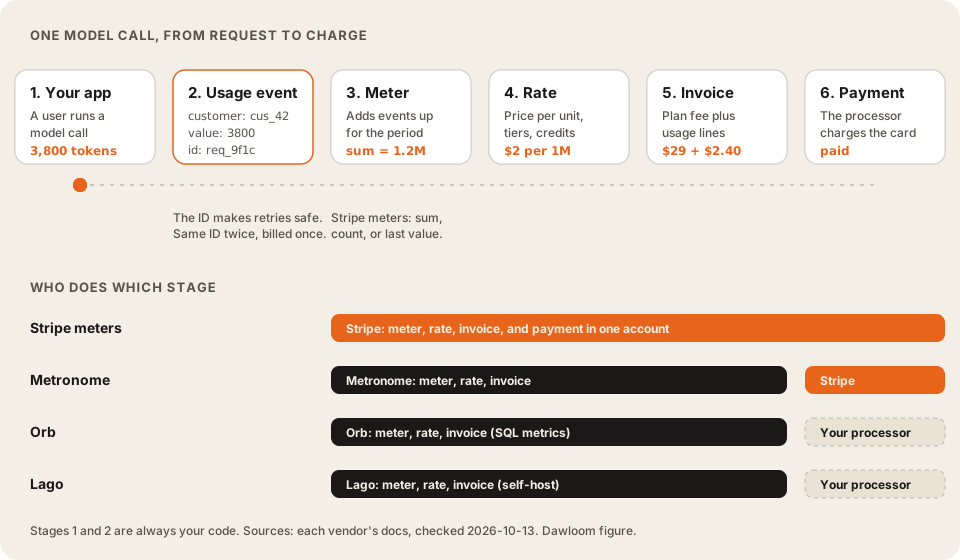
Stages 1 and 2 are always your code. The single most important field is the idempotency key on each event. Your app will retry a failed send, and without the key a retry bills the customer twice. All four tools dedupe on it:
- Stripe meters take an
identifierper event. Stripe’s docs: “Use idempotency keys to prevent reporting usage for each event more than one time because of latency or other issues.” - Metronome uses
transaction_idand ignores repeats for 34 days. - Orb offers “per-event idempotency through the API to guarantee that duplicates are never processed within the account grace period” (Orb docs).
- Lago uses
transaction_id: “if the same event arrives twice, it is billed once” (Lago docs).
Here is the smallest working usage event on Stripe. Use your own request ID as the identifier, so a retry sends the same one:
curl https://api.stripe.com/v1/billing/meter_events \
  -u "$STRIPE_SECRET_KEY:" \
  -d event_name=ai_tokens \
  -d "payload[stripe_customer_id]=cus_42" \
  -d "payload[value]=3800" \
  -d identifier=req_9f1c
The comparison
| Stripe Billing meters | Metronome | Orb | Lago | |
|---|---|---|---|---|
| Owner (2026) | Stripe | Stripe, since January 2026 | Adyen, deal announced June 2026 | Independent, open source |
| Published price | 0.7% of billing volume | 0.8% of billing volume plus $0.04 per 1,000 events (Startup plan) | No. “Custom pricing” on every plan | $0 license for open source. Premium is “Custom quote” |
| Events included | Up to 100M per month | Charged per event | Priced on billings and events | No per-event fee when you self-host |
| How usage adds up | Sum, count, or last value (docs) | Billable metrics, plus dimensional pricing | Filters and aggregations, or custom SQL (docs) | Count, unique count, sum, max, latest (docs) |
| Prepaid credits | Yes, but only reconciled at invoice time | Yes, with real-time burndown | Yes, per Orb’s docs | Premium feature, per Lago’s pricing docs |
| Enterprise commits and ramps | No | Yes | Yes | Premium feature |
| Who collects payment | Stripe | Stripe | Stripe today. Adyen intends to converge billing and payments | A processor you connect, such as Stripe |
| Runs on your servers | No | No | No | Yes, under AGPL-3.0 |
Sources, all checked 2026-10-13: Stripe Billing pricing, Stripe’s Metronome comparison, Metronome pricing, Orb pricing, Lago pricing.
Fees at three revenue levels
This table prices only the billing software. Card processing is the same on top of every option if you collect through Stripe: 2.9% + 30¢ per successful US card charge (stripe.com/billing/pricing, checked 2026-10-13).
To compare per-event fees we had to pick an event volume. We assumed one event per model request and $0.01 of revenue per event. So $10,000 a month means 1 million events. That is our assumption, not a vendor figure. Change it and the Metronome column changes.
| Monthly billing volume | Events per month | Stripe Billing, pay as you go | Stripe Billing, annual plan | Metronome Startup | Orb | Lago open source |
|---|---|---|---|---|---|---|
| $10,000 | 1M | $70 (0.7%) | Not worth it. The smallest plan is $620 | $120 ($80 + $40 events) | Not published | $0 license, plus your hosting and upkeep |
| $100,000 | 10M | $700 | $620 (covers up to $100,000) | $1,200 ($800 + $400 events) | Not published | $0 license, plus your hosting and upkeep |
| $1,000,000 | 100M | $7,000 | $5,750 (covers up to $1,000,000) | $12,000 ($8,000 + $4,000 events) | Not published | $0 license, plus your hosting and upkeep |
What the table shows:
- Stripe meters are the cheapest published option at every level. Stripe’s annual plans, “Annual subscription, paid monthly,” drop the effective rate to 0.62% at $100,000 and 0.575% at $1,000,000.
- Metronome’s event fee grows with volume. In our assumption it adds half again on top of the 0.8%, for 1.2% in total. If you send one event per user per hour instead of one per request, the event fee shrinks a lot. If your price per event is lower than a cent, it grows.
- We could not find whether Stripe’s 0.7% also applies to invoices Metronome creates. Stripe’s pricing page shows “Contact Metronome” for Metronome features. Ask before you sign.
- Orb publishes no prices. Its pricing page says “We base our pricing on two key metrics: billings and events,” and adds a platform fee on the Advanced and Enterprise plans. You only get a number from sales.
- Lago’s $0 is the license, not the cost. Lago’s own docs say “infrastructure and operating costs are not included.” Your team runs the hosting, backups, upgrades, and monitoring. We did not price that, because it depends on your stack.
Which one to pick
Stripe Billing meters: plan plus overage, already on Stripe
Pick it when your pricing is a monthly plan with an allowance and an overage rate, or plain pay as you go. It works with Stripe Checkout, the customer portal, and the Stripe Dashboard, where Stripe’s own table marks Metronome as “Limited” or unsupported.
The catch is Stripe’s own advice. Its usage-based billing docs now say: “Unless you’re maintaining an existing Billing Meters integration, use Metronome.” Stripe also says it “will continue to fully support basic usage-based billing for existing users.” We read that as: meters are safe for simple pricing today, but new features will land on Metronome. If you expect to add credits or contracts within a year, start on Metronome instead.
Know the limits before you build:
- Meter events are limited to “1000 calls per second per Stripe account” and “one concurrent call per customer per meter.” The v2 event stream goes to 10,000 per second.
- Event timestamps must be “within the past 35 calendar days and isn’t more than 5 minutes in the future.”
- You can only cancel a bad event within 24 hours.
Metronome: prepaid credits that run down in real time
Many AI products sell credits. A customer buys $50 of credits and each model call draws them down. On Stripe meters, Stripe’s comparison page is blunt: “Credits are only reconciled at invoice time. Customers can exceed their balance during the cycle.” For an AI product where one heavy user can burn tokens fast, that gap costs money.
Metronome does real-time credit burndown, commits, minimum spend, ramp schedules, and dimensional pricing, such as a different rate per model on one meter. Stripe describes the split this way: “Metronome handles metering, rating, and billing, while Stripe handles payment collection, tax calculation, and revenue recognition.” The Startup plan is self-serve. Data exports and Salesforce or NetSuite invoicing sit on the Custom plan.
Orb: sales-led contracts and complex metrics
Orb fits when a sales team negotiates each contract and finance wants to test a price change against past usage before rolling it out. Its billable metrics can be written as SQL over your raw events, which handles pricing that a sum or count can’t express. Orb’s ingestion API defaults to “10,000 events per minute,” described as “a default rather than a hard ceiling.”
Two things to weigh. Orb publishes no prices, so you can’t budget it without a sales call. And Adyen now owns it. Adyen’s press release says it will keep “continuing to support multi-PSP environments” during the first phase, and that after it, “the strategic intent is convergence.” If you collect payments through Stripe and plan to keep doing so, ask Orb in writing how long that stays supported.
Lago: your servers, your data, no revenue share
Lago’s open-source edition covers customers, plans, subscriptions, usage metering, and invoicing, under AGPL-3.0. It integrates with Stripe to collect payment: Lago creates the payment intent and “Stripe will record the invoice ID and process the payment” (Lago’s Stripe docs).
Pick it when billing data must stay on your infrastructure, or when a percentage of revenue will cost more than an engineer’s time to run it. Its event batch endpoint takes “up to 100 events per request,” and Lago notes that “Batches are atomic,” so one bad event rejects the whole batch. Credits, alerts, entitlements, and the customer portal are listed under Premium. If you plan to change Lago’s code, read the AGPL with a lawyer first.
Do you need any of these yet?
Maybe not. If you have one plan with a monthly allowance, you can count usage in your own database and send one meter event per customer per day to Stripe. You still need idempotent writes and a job that doesn’t drop events. Our post on background jobs that don’t fall over covers that part, and Stripe subscription patterns covers the webhook side.
Set your prices before you pick the tool. How to price an AI SaaS works out where a heavy user stops paying for themselves, which tells you whether you need an allowance, credits, or both.
FAQ
What is the best usage-based billing tool for an AI SaaS?
For a small team already on Stripe with a plan-plus-overage model, Stripe Billing meters. It has the lowest published fee of the four (0.7%) and the best fit with Checkout and the customer portal. If you sell prepaid credits, use Metronome, because Stripe meters only reconcile credits at invoice time.
Is Stripe Billing good enough for metered AI pricing?
For sum, count, or last-value pricing, yes, up to 100 million events a month included. It falls short on real-time credit balances, enterprise commits, and a different rate per model on one meter. Stripe’s own docs send those cases to Metronome.
How much does Metronome cost?
Metronome’s Startup plan lists 0.8% of billing volume plus $0.04 per 1,000 ingested events, checked 2026-10-13. At $100,000 a month and 10 million events that is $1,200. The Custom plan has no published price.
Is Lago really free?
The open-source license is free under AGPL-3.0. You pay for the servers, backups, upgrades, and the engineer who keeps it running. Lago Premium, cloud or self-hosted, is priced by quote.
What happened to Orb and Metronome?
Stripe finished buying Metronome in January 2026, and it is now Stripe’s main usage-based billing product. Adyen announced a $335 million deal for Orb on June 11, 2026, with closing expected July 1, 2026. Both still sell to new customers as of 2026-10-13.
We build AI SaaS products with billing, usage limits, and credits wired in from the first version. See AI SaaS development.