
For most stores, a connector app is the right way to sync Shopify inventory with an ERP: Microsoft’s Business Central connector is free to install, Oracle’s NetSuite Connector starts at $199.92 a month, and Celigo’s NetSuite app starts at $7,800 a year (all checked 2026-10-13). Build a custom integration when your ERP has no maintained connector, when you sell serialized or kitted stock the app can’t model, or when a 15-minute stock delay costs you oversold orders.
Who this is for: e-commerce and operations leads running Shopify next to an ERP or inventory system, with more than one stock location. Who should look elsewhere: if you sell from one warehouse and Shopify is your only stock record, you don’t need a sync at all. Use Shopify’s own inventory.
How we checked
We read each app’s Shopify App Store listing or the vendor’s pricing page, and Shopify’s and Microsoft’s developer docs, on 2026-10-13. Prices are in US dollars as the listings show them, before tax. We didn’t install the apps, so the schedules below are what vendors document. We didn’t measure them. The cost of a custom build comes from agencies that publish their own ranges. We say whose number each one is.
The pages that rank for this question today come from connector vendors and agencies. The most complete one we found, Elogic’s ERP integration guide, has a good failure-mode table but no per-app prices, no check dates, and no Shopify rate-limit numbers. Shopify’s own ERP article names “sync lag or data corruption” as risks and stops there. This page adds the numbers.
What the apps cost over three years
| Option | What it syncs | How often (documented) | Price | 3 years |
|---|---|---|---|---|
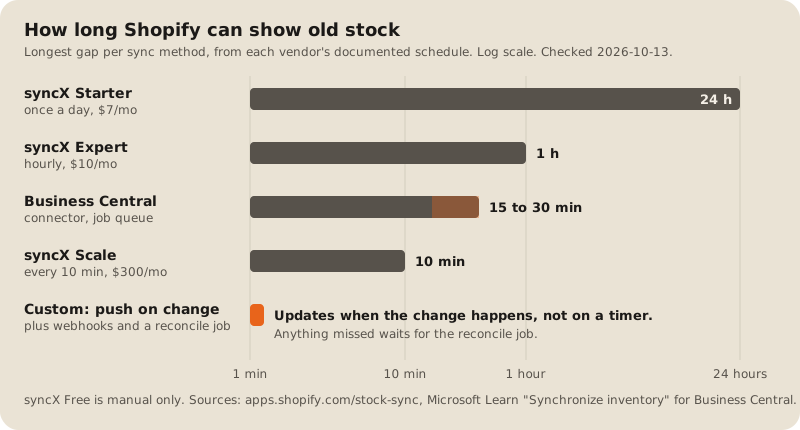
| Business Central connector (Microsoft) | Items, stock, customers, orders, fulfilments. More than one shop and location. | Scheduled. Microsoft suggests every 15 to 30 minutes. | Free to install. Business Central licence not included. | $0 + licence |
| NetSuite Connector (Oracle) | Products, prices, stock, orders, fulfilment. Multi-location. | ”Real-time option” for price and quantity. No interval given otherwise. | $199.92/mo B2C Standard. $916.58/mo B2B. | $7,197 to $32,997 |
| NetSuite Integration by Celigo | Customers, items, orders, refunds, returns. Stock from warehouses, including kits. | Tagged “Real-time sync”. No interval given. | $7,800/yr Starting. $18,900/yr Standard. | $23,400 to $56,700 |
| Cin7 Core | An inventory system with a Shopify integration. Unlimited locations. | Not on the pricing page. | $349/mo Standard, capped at 6,000 sale orders a year. | $12,564 |
| Prediko | Inventory planning and stock sync, orders, multi-store. | ”Syncs in real time”. No interval given. | $199/mo Growth, for up to $2M in revenue. | $7,164 |
| syncX: Stock Inventory Sync | Stock, price, and variants from a supplier or ERP feed (CSV, FTP, Google Sheets, API). | Daily on Starter, hourly on Expert, up to every 10 minutes on Scale. | $7, $10, or $300/mo. | $252 to $10,800 |
| Alumio (integration platform) | Whatever you configure. A general integration platform. | Not stated. | From EUR 499/mo. Partner setup billed separately. | EUR 17,964 + setup |
| Custom integration | Whatever your ERP and stock rules need. | Push on change, webhooks back, plus a reconcile job. | Build price, then hosting and upkeep. See below. | Quote |
Pipe17 and Brightpearl don’t publish prices. Pipe17 says it prices on “order volume, connections, flows, and sub-accounts” plus a one-time setup charge (pricing). We left them out of the table rather than guess.
Two things the table hides. First, the ERP licence is usually the bigger bill, and none of these prices include it. Second, the cheap rows sync from a feed on a timer. That’s fine for a dropshipper with one supplier. It’s not fine for a store with three warehouses and a busy weekend.
What a custom build costs
We don’t have a public price for this yet. These are the ranges agencies publish themselves, so treat them as each agency’s own numbers:
- Elogic Commerce (guide, updated 2026-10-13): “$20,000-$50,000” for a connector-led project in 6 to 10 weeks, “$50,000-$150,000” with an integration platform, and “$150,000-$400,000+” for custom enterprise work. Their own caveat: “These are scoping ranges, not market benchmarks or fixed quotes.”
- Kinex Media (ERP integration page): businesses “in the $5M-$50M range typically invest between $15,000 and $100,000+”.
Then add the running cost. A custom sync is a small always-on service: a worker, a queue, a database table of what it has seen, and alerts. Someone also has to update it when Shopify changes its API. Shopify “releases a new API version every three months” and supports each one for “a minimum of 12 months” (versioning), and as of version 2026-04 the stock mutation needs an idempotency key it didn’t need before. That’s the kind of change an app vendor absorbs for you and a custom build doesn’t.
How each one fails
A Shopify inventory sync can fail in at least nine documented ways, from stale stock between scheduled runs to webhooks Shopify never delivers. Apps and custom builds hit the same Shopify limits. What differs is who is watching. Each row below quotes Shopify’s or Microsoft’s own docs.
| Failure | What goes wrong | Connector apps | Custom build |
|---|---|---|---|
| Stale stock between syncs | A scheduled sync shows the old number until the next run. You oversell the last unit. | Business Central runs on a job queue, “every 15-30 minutes” by Microsoft’s suggestion. syncX runs daily to every 10 minutes by plan. | Push the change when it happens. Keep a slower sweep as a backstop. |
| Missed webhook | An order in Shopify never reaches the ERP, so the ERP oversells on another channel. | Up to the vendor. Most listings don’t say how they recover. | Shopify says “Webhook delivery isn’t always guaranteed” and suggests “reconciliation jobs to periodically fetch data” (best practices). Run one. |
| Webhook endpoint down | Shopify stops sending events at all. | The vendor runs the endpoint. | A reply over five seconds fails. Shopify “retries failed webhook calls up to eight times in a four-hour period” and then “the subscription is removed” (troubleshooting). Alert on it. |
| Events out of order | An old stock level lands after a new one and overwrites it. | Not documented by the listings we read. | ”Shopify doesn’t guarantee ordering within a topic.” Compare timestamps before you apply a change. |
| Two writers at once | The ERP and a staff edit both set stock. One wins silently. | Depends on which API the app calls. | inventorySetQuantities compares the expected quantity first and errors if it changed. Shopify warns that skipping that check “can lead to inaccurate inventory quantities” (docs). |
| Retry applies twice | A timed-out request is sent again and stock moves twice. | The vendor’s problem. | ”As of 2026-04, the idempotency key is required.” Send one per change. |
| New location | You open a store. Its stock never shows online. | Business Central: “the connector doesn’t synchronize inventory levels for such items in the new location” until you add inventory records for it. | Map locations in config and fail loudly on an unknown one. |
| Bundles and kits | A bundle’s stock depends on its parts. | Microsoft notes Shopify Bundles “prevents updates via APIs” for the bundle item. Celigo documents kit and assembly items. | Compute bundle stock from parts in your own code. |
| Full resync hits rate limits | A catalog-wide check runs for hours or gets throttled. | Handled by the vendor, within the same limits. | GraphQL allows 100 points a second on standard plans, 200 on Advanced, 1,000 on Plus (rate limits). Use bulk operations, which aren’t rate limited, for the diff. |
A few of those rows are about Shopify itself. A missed webhook or an out-of-order event happens to everyone. What differs is who is watching for it. With an app, ask the vendor in writing how it recovers. With a custom build, the reconcile job is the answer, and it’s the part teams most often skip. Our post on keeping Shopify in sync with an inventory system walks through that design, with the webhook handler code.
When to pick which
Pick a connector app when:
- Your ERP has a connector maintained by the ERP vendor or a large integrator. Business Central and NetSuite both do.
- Each product is tracked as a count. No unit has its own serial number.
- A delay of 15 to 30 minutes on stock is fine for your sales speed.
- You’d rather pay a yearly fee than own a service.
Pick a custom integration when:
- Your ERP or inventory system is custom, old, or has no maintained connector.
- You sell serialized stock, where each unit has its own record, or kits whose stock depends on their parts.
- You need stock rules the app can’t express, such as holding back safety stock per location or reserving units for showroom orders.
- You already have developers who will own it after launch.
Pick neither yet when your stock lives in a spreadsheet. Fix that first. The signs your spreadsheet just became an ERP covers when to move.
What we’ve built
Our client FurnitureAxis runs a C# background worker that pushes products and stock from its own platform to Shopify on a schedule. That’s the custom route, chosen because the system of record is a custom platform with no off-the-shelf connector. We don’t have a NetSuite or Business Central build to show, so we won’t claim one.
If you’re deciding between an app and a build, our e-commerce development page explains how we scope it. If you’d rather hire a specialist, we scored the agencies that do Shopify ERP integration on their public proof.
FAQ
Can Shopify sync inventory with an ERP in real time?
Shopify itself can, through its Admin API and webhooks. Whether your setup is real time depends on the connector. Microsoft’s Business Central connector syncs on a job queue, and Microsoft suggests every 15 to 30 minutes. A custom integration can push each change as it happens.
How much does a Shopify ERP integration cost?
Connector apps run from free (Business Central, plus your licence) to $18,900 a year (Celigo’s Standard NetSuite package), checked 2026-10-13. Agencies that publish ranges quote $15,000 to $400,000 or more for a build, depending on scope.
Does Shopify have a built-in ERP?
No. Shopify tracks stock per location, up to 10 locations on Basic, Grow, and Advanced and 200 on Plus (locations help). Purchasing, accounting, and manufacturing live in an ERP or inventory system you connect.
Why does my Shopify inventory keep going out of sync?
The usual causes are a scheduled sync that runs too rarely, a webhook that never arrived, an old update applied after a newer one, or two systems writing stock at the same time. A reconciliation job that compares both sides on a timer catches all four.
Should I use Celigo or a custom integration for NetSuite?
Use Celigo or Oracle’s NetSuite Connector if your flows are standard orders, stock, and fulfilment. Their prices are public on the Shopify App Store. Go custom only if you need logic neither can express, and if you have a team to run it.