
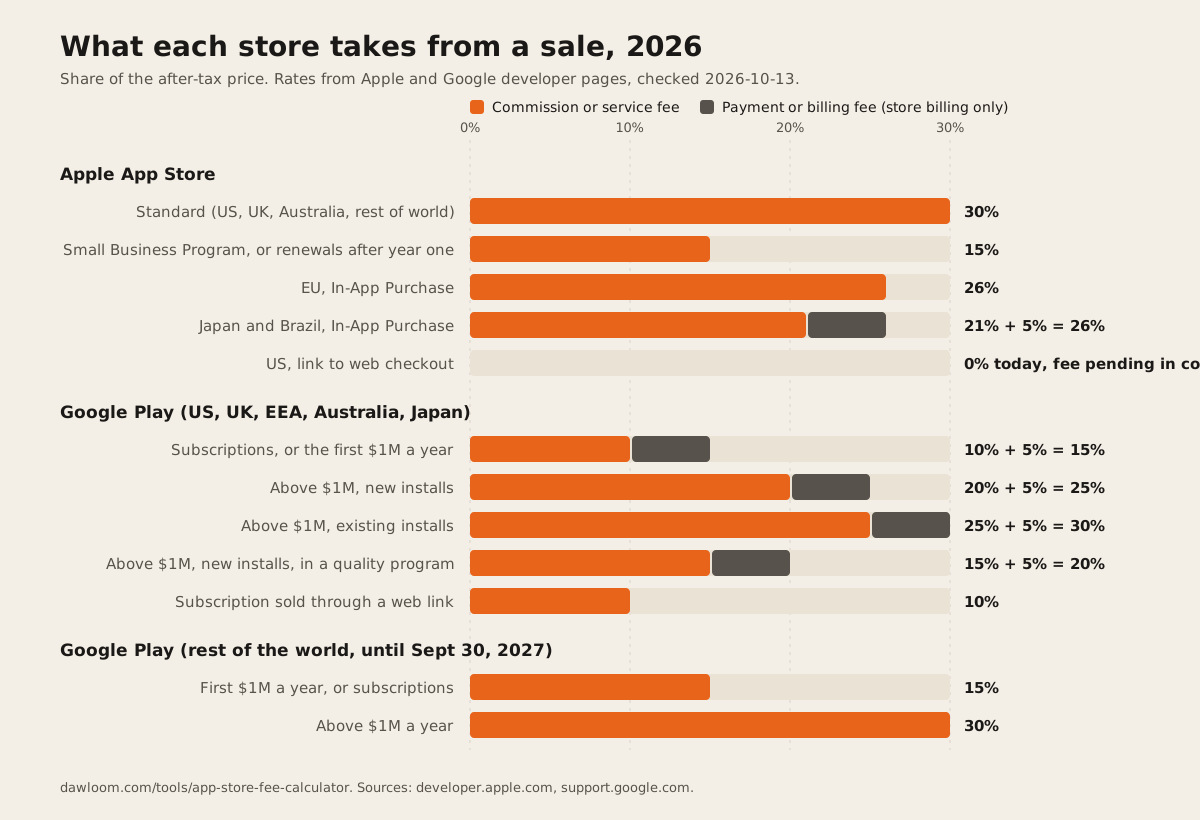
Apple takes 30% of a sale, or 15% if you’re in its Small Business Program or the sale is a subscription renewal after the first paid year. Google Play now charges a 10% service fee plus a 5% billing fee on subscriptions and on your first $1M a year in the US, UK, EEA, Australia, and Japan, and up to 25% + 5% on other sales above $1M.
The calculator below puts both stores side by side for your region, revenue, and programs. Every rate links to Apple’s or Google’s own page, and we checked each one on 2026-10-13.
Who this is for: founders and product owners pricing an app with paid downloads, in-app purchases, or subscriptions. Who should use something else: if you sell physical goods or real-world services in your app, store fees don’t apply to those sales, and your payment processor’s pricing is the number that matters.
Apple App Store
$212,500
you keep, 85% of sales
- Store fees
- $37,500
- Total fees
- 15%
- 15% on $250,000 (Small Business Program)
Standard worldwide terms. Source, checked 2026-10-13
Google Play
$212,500
you keep, 85% of sales
- Store fees
- $37,500
- Total fees
- 15%
- 10% service fee on $250,000
- 5% billing fee for Google Play Billing
New model since June 30, 2026: 10% service fee on all auto-renewing subscriptions. Source, checked 2026-10-13
Both stores leave you the same amount on these inputs.
This is a planning number, not an invoice. It assumes all sales come from one region and are spread evenly over the year. It leaves out refunds, currency conversion, and the developer account fees (Apple $99 a year, Google $25 once).
Every rate, with its source
All checked 2026-10-13 on the official pages. We measured nothing here ourselves. These are the vendors’ own published rates.
| Store | Where | What it covers | Rate |
|---|---|---|---|
| Apple | Worldwide (US, UK, Australia, rest of world) | Paid apps and In-App Purchase, standard | 30% checked 2026-10-13 |
| Apple | Worldwide | Small Business Program (under $1M proceeds last calendar year, enrolled) | 15% checked 2026-10-13 |
| Apple | Worldwide | Auto-renewable subscriptions after one year of paid service | 15% checked 2026-10-13 |
| Apple | United States | Link to your own website checkout | 0% today (court still setting a fee) checked 2026-10-13 |
| Apple | EU | In-App Purchase, standard / reduced | 26% / 15% checked 2026-10-13 |
| Apple | EU | Your own payment processor inside the app, standard / reduced | 20% / 10% checked 2026-10-13 |
| Apple | EU | Link-out to a website (sales within 7 days), standard / reduced | 15% / 10% checked 2026-10-13 |
| Apple | EU | Core Technology Commission, apps outside the App Store | 5% checked 2026-10-13 |
| Apple | Japan and Brazil | Commission, standard / reduced | 21% / 10% checked 2026-10-13 |
| Apple | Japan and Brazil | Payment processing fee when you use In-App Purchase | +5% checked 2026-10-13 |
| Apple | Japan and Brazil | Link-out to a website (sales within 7 days), standard / reduced | 15% / 10% checked 2026-10-13 |
| US, UK, EEA (from June 30, 2026); Australia, Japan (from Sept 30, 2026) | Auto-renewing subscriptions, all installs | 10% + 5% billing fee checked 2026-10-13 | |
| Same regions | First $1M of annual earnings, all transactions | 10% + 5% billing fee checked 2026-10-13 | |
| Same regions | Other transactions above $1M, new installs | 20% + 5% billing fee checked 2026-10-13 | |
| Same regions | Other transactions above $1M, existing installs | 25% + 5% billing fee, or 20% via web links checked 2026-10-13 | |
| Same regions | Apps Experience or Games Level Up program, above $1M, new / existing installs | 15% / 20% + 5% billing fee checked 2026-10-13 | |
| Same regions | Billing fee when you use alternative billing or web links | 0% checked 2026-10-13 | |
| All other markets (until the rollout) | First $1M a year, enrolled in the 15% tier | 15% checked 2026-10-13 | |
| All other markets | Earnings above $1M a year | 30% checked 2026-10-13 | |
| All other markets | Auto-renewing subscriptions | 15% checked 2026-10-13 |
What we found on Google’s “10% + 5%” split
Our plan for this page said Google split its fee into 10% + 5% after June 30, 2026. That’s right, but only for part of your sales. Here is what Google’s own pages say.
- The split is real. Google’s Android Developers Blog (24 June 2026) says: “the service fee starts at 10% on your first $1M (USD) in annual earnings. This 10% service fee also applies to all auto-renewing subscriptions.” The lower service fees page adds: “In the AU, JP, US, UK, and the European Economic Area (EEA), the billing fee is set at 5%.” Checked 2026-10-13.
- Australia and Japan joined later. The new fees started on June 30, 2026 in the EEA, UK, and US, and on September 30, 2026 in Australia and Japan, per Google’s service fees page (checked 2026-10-13). South Korea follows on December 31, 2026 and the rest of the world on September 30, 2027.
- 10% + 5% is still 15% for most apps. If you use Google Play Billing, the billing fee brings subscriptions and your first $1M back to 15%, the same as before. The saving only shows up when you use alternative billing or a web link, where the 5% billing fee drops off.
- Sales above $1M got a new split. One-time sales above $1M pay 20% + 5% from users who installed after the rollout date, and 25% + 5% from users who installed before it. The new Apps Experience and Games Level Up programs cut those to 15% and 20%, but only after you enroll and pass Google’s validation. Enrollment is open to accounts with at least $1M in earnings over the last 12 months.
- Some calculators haven’t caught up. On 2026-10-13, AppStills still showed Google as a flat 15% then 30%, with no check date and no source links. That is still correct for buyers outside the new-model regions. It’s wrong for US, UK, EEA, Australian, and Japanese buyers above $1M.
Apple’s rates, region by region
Standard and Small Business Program. Apple’s Small Business Program page (checked 2026-10-13) sets “a reduced commission rate of 15% on paid apps and Apple In-App Purchases” for developers with up to $1M in proceeds in the prior calendar year. Proceeds are your sales after Apple’s cut. If you pass $1M during the year, the standard rate applies to the rest of the year. You also have to enroll. It isn’t automatic.
Subscriptions after year one. Apple’s subscriptions page says: “After a subscriber accumulates one year of paid service, your net revenue increases to 85% of the subscription price, minus applicable taxes.” Small Business Program members get 85% from the first month.
The EU. Apple moved every EU app to one set of terms on October 1, 2026. Its EU page (checked 2026-10-13) lists 26% for In-App Purchase, 20% if you use your own processor inside the app, and 15% on website sales within 7 days of a link tap. The reduced rates are 15%, 10%, and 10%. Apps sold outside the App Store pay a 5% Core Technology Commission, which replaced the old per-install Core Technology Fee.
Japan and Brazil. Both split Apple’s cut into a 21% commission and a 5% fee for using In-App Purchase. The reduced commission is 10%. See Apple’s Japan and Brazil pages, checked 2026-10-13.
US web link-outs. Apple’s App Review Guidelines say purchase-link entitlements “are not required for developers to include buttons, external links, or other calls to action in their United States storefront apps.” Apple takes no commission on those sales today. That may change. In August 2026, 9to5Mac reported that Apple proposed up to 15% (5% for small developers) to the court in Epic v. Apple. No rate had been set when we checked.
The UK and Australia. Apple’s standard worldwide terms still apply. The UK regulator’s proposed steering rules were still under review when we checked.
Worked examples
These come straight from the calculator’s code, so the tool and this table always agree.
| Scenario | Apple fees | Apple, you keep | Google fees | Google, you keep |
|---|---|---|---|---|
| US subscription app, $250k a year, small developer | $37,500 (15%) | $212,500 | $37,500 (15%) | $212,500 |
| US paid app or in-app purchase, $250k a year, small developer | $37,500 (15%) | $212,500 | $37,500 (15%) | $212,500 |
| US in-app purchases, $3M a year, past both small-developer limits, new installs | $900,000 (30%) | $2,100,000 | $650,000 (21.7%) | $2,350,000 |
| EU in-app purchases, $3M a year, past both limits, existing installs | $780,000 (26%) | $2,220,000 | $750,000 (25%) | $2,250,000 |
| Rest of world in-app purchases, $3M a year, past both limits | $900,000 (30%) | $2,100,000 | $750,000 (25%) | $2,250,000 |
| US subscription sold on the web through a link-out, $250k a year | $7,250 (2.9%) | $242,750 | $32,250 (12.9%) | $217,750 |
Two things stand out. Below $1M, the stores cost the same for most apps: 15%. Above $1M, Google is now cheaper than Apple in the US, by about 8 points on new installs. And a US subscription sold through a web link keeps the most, but only if the drop in conversion from leaving the app costs you less than the fee you save. We haven’t measured that drop for our clients, so test it on your own app before you switch.
What the calculator leaves out
- Mixed regions. It assumes all sales come from one region. If you sell in many, run it per region and add the results.
- South Korea and India. Google cuts its fee by 4 points for alternative billing there. Apple has separate Korea terms. Neither is modeled.
- Partner programs. Apple’s Mini Apps, Video, and News partner programs have their own rates.
- Account fees. Apple charges $99 a year and Google charges a $25 one-time registration fee. Both checked 2026-10-13.
If you’re building an app and want billing designed for these rules from the start, that’s part of our mobile app development work. For the billing code itself, our notes on Stripe subscription patterns cover the webhook side of web checkout. If you’re still picking a stack, read Expo or bare React Native and React Native or .NET MAUI.
The calculator also lives on its own page: App Store and Google Play fee calculator.
FAQ
How much does Apple take from app sales in 2026?
30% by default. 15% if you’re enrolled in the Small Business Program, or for subscription renewals after the subscriber’s first paid year. EU In-App Purchase is 26%, and Japan and Brazil are 21% plus a 5% processing fee. Checked 2026-10-13.
Is the Google Play fee really 10% now?
The service fee is 10% on subscriptions and on your first $1M a year in the US, UK, EEA, Australia, and Japan. Google Play Billing adds a 5% billing fee, so most apps still pay 15% in total. You only pay 10% if you use alternative billing or a web link.
Does the 15% Small Business rate apply automatically?
No. Apple asks you to enroll in App Store Connect and list any associated developer accounts. Google’s first-$1M tier needs an Account Group in Play Console. Until you enroll, you pay the standard rate.
Can I skip the store fee by sending users to my website?
In the US, Apple takes no commission on link-outs today, but a court may set one. Google still charges its service fee on link-outs and drops only the 5% billing fee. In the EU, Japan, and Brazil, Apple charges 15%, or 10% reduced, on website sales within 7 days of the tap. Your card processor also takes a cut.
Do Apple and Google take a cut of physical goods sold in my app?
No. Store fees apply to digital goods and services. Physical goods and real-world services, like a food order or a ride, go through your own payment processor.