
To hire a .NET MAUI developer, ask first for two links: one app they built with MAUI in the App Store and one in Google Play. Then ask how they will move your app to the next .NET version each year, because Microsoft supports each MAUI version for only about 6 months after the next one ships.
Who this is for: a company that has picked .NET MAUI, often because its backend or desktop software is already C#, and now needs someone to build the app. Who should read something else: if you have not chosen a stack yet, start with React Native or .NET MAUI. If you only need a Windows desktop app, Avalonia vs MAUI vs WPF may point you elsewhere.
Who builds .NET MAUI apps
Most MAUI developers came from one of two places: Xamarin.Forms, which MAUI replaced, or .NET desktop work such as WPF. Here are the usual places to look. This is not a ranking. For named companies scored against the stores, see our list of .NET MAUI agencies.
| Option | Good for | Watch out for |
|---|---|---|
| A .NET agency | A whole app with backend, design, store release, and support | Many list MAUI next to every other .NET skill. Ask for a MAUI app in the stores |
| A former Xamarin shop | Moving an old Xamarin.Forms app to MAUI | Old habits, such as custom renderers where MAUI now uses handlers |
| A freelancer | A small app, or one feature in a bigger one | One person holds the knowledge, and often the signing keys too |
We are one of the agencies that build with .NET MAUI. We wrote this guide, so weigh that. Our rate is $30 an hour, or by milestone. We have shipped a .NET MAUI point-of-sale app that runs on Android, iOS, macOS, and Windows. It is live in the stores and in use today. We can’t name the client or the app in public, so check 1 below applies to us too: ask to see it running. Rahib Khan worked on it.
The 7 checks
| # | Ask for | What a good answer looks like |
|---|---|---|
| 1 | Apps live in the stores | Links to MAUI apps in the App Store and Google Play, or a live demo when the client can’t be named |
| 2 | Their upgrade plan | They name the .NET version they would start on and when they would move to the next one |
| 3 | A handler they wrote | They show how they changed one control on one platform, without a renderer |
| 4 | How they build for iOS | They name the Mac or the cloud build service they use |
| 5 | Where the Android key lives | A keystore with a backup, stored where you can reach it |
| 6 | Screens on every target you need | Real screenshots from each phone and desktop system in your plan |
| 7 | A plan for accounts and keys | The repo, the store accounts, and the signing keys end up in your name |
1. Apps live in the stores
A store link is proof you can check in a minute. Many business apps, such as point-of-sale or field service apps, belong to clients who don’t allow their name in a portfolio. In that case, ask the developer to show the app running on a real device in a video call, and to show you the store listing, even if they can’t send it. Ask which apps were built with MAUI and which with Xamarin. Microsoft’s upgrade guide says “Microsoft support for Xamarin will end on May 1, 2024 for all Xamarin SDKs including Xamarin.Forms.” A portfolio of only Xamarin apps is old work.
2. Their upgrade plan
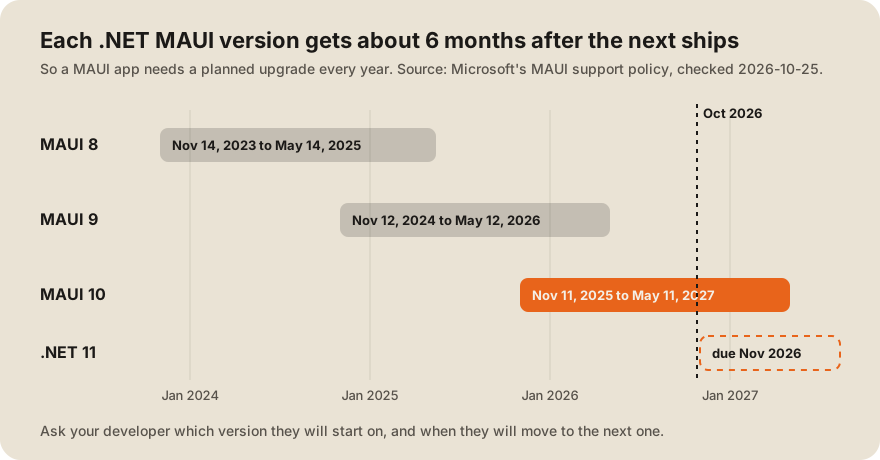
MAUI moves with .NET, once a year. Microsoft’s MAUI support policy says “A major version of .NET MAUI receives support for a minimum of 6 months after a successor (the next major release) ships.” The same page lists .NET MAUI 10, released November 11, 2025, with support ending May 11, 2027 (checked 2026-10-25).
So a MAUI app needs a planned upgrade every year. Ask the developer how they moved an app from one version to the next, how long it took, and what broke. Put the yearly upgrade in your budget, not in “maintenance if needed”.
3. A handler they wrote
In MAUI, each control is drawn by a native control on each platform. Microsoft’s handlers page says “Handlers map these virtual views to controls on each platform, which are known as native views.” Changing how a control looks on one platform is done by customizing its handler.
Ask them to show one handler change from a past project and explain it. Someone who only knows Xamarin.Forms will reach for a custom renderer. If you are moving an old app, that cost is covered in Xamarin to .NET MAUI migration cost.
4. How they build for iOS
Microsoft’s supported platforms page says “a networked Mac is required for iOS development.” The Pair to Mac guide explains why: iOS builds need “Apple’s build tools, which only run on a Mac.”
Ask what Mac they build on, or which cloud build service. A team with no Mac will be slow every time you need an iOS release.
5. Where the Android key lives
Every Android update must be signed with the same key. Microsoft’s Google Play publishing guide warns that the keystore “isn’t saved to your Visual Studio solution. Therefore, ensure you back up this data. If you lose it you’ll be unable to sign your app with the same signing identity.”
Ask where the keystore and its password will be kept. The right answer is a secret store you control, with a backup, not one developer’s laptop.
6. Screens on every target you need
MAUI covers Android, iOS, macOS through Mac Catalyst, and Windows. The supported platforms page lists those four. It does not list Linux. If you need Linux, MAUI is the wrong pick.
The same screen can look different on each system, because each one uses native controls. Ask for screenshots from a real phone and a real desktop for every target in your plan.
7. A plan for accounts and keys
By the end, you should own the code repository, the Apple developer account, the Google Play account, and the Android keystore. Apple’s enrollment page says the person who enrolls an organization becomes the Account Holder, and must be “the organization’s owner/founder, executive team member, senior project lead, or an employee with legal authority.” So the account should be yours, not the developer’s. Put this in the contract. Who owns the code covers the clauses to ask for.
A one-day paid test
If you’re unsure, pay for one day of work before you commit to the full project. Ask for this:
- A MAUI app with one page that loads a list from a public API.
- One handler change on one platform, with a short note on why.
- A signed Android build on Google Play’s internal testing track, in your account.
- An iOS build in TestFlight, in your Apple account.
Keep the task this small on purpose, so it fits in one paid day. Steps 3 and 4 also test whether they can work inside your accounts, which they will do for the whole project. Our guide to vetting an offshore team before you send money has more checks that apply to any stack.
What you pay besides the developer
- Apple Developer Program: “99 USD per membership year”, per Apple (checked 2026-10-25). Organizations also need a D-U-N-S Number.
- Google Play: a “one-time $25 registration fee”, per Microsoft’s Google Play guide (checked 2026-10-25).
- A Windows signing certificate, if you ship a Windows app outside the Microsoft Store. See code signing certificate cost.
- The yearly .NET upgrade, from check 2.
If you want us to build it, our mobile app development page has the details, and our .NET MAUI notes say when we pick it and when we don’t.
FAQ
Is it hard to find a .NET MAUI developer?
Harder than a React Native developer, because the pool is smaller. Many C# developers have used MAUI, but fewer have shipped a MAUI app to both stores. Ask for store links, not a skills list.
Can a Xamarin developer build a MAUI app?
Usually, yes. MAUI grew out of Xamarin.Forms, and Microsoft’s upgrade guide says Xamarin projects “don’t need to be rewritten.” Check that they know handlers and the yearly .NET upgrade, since both are new since Xamarin.
Do I need a Mac to build a .NET MAUI app?
Only for iOS. Microsoft says “a networked Mac is required for iOS development.” Android and Windows builds run on Windows.
Does .NET MAUI run on Linux?
No. Microsoft lists Android, iOS, macOS through Mac Catalyst, and Windows. For a desktop app that must also run on Linux, look at Tauri or Avalonia.
How often does a MAUI app need upgrading?
Plan for once a year. Each major MAUI version gets at least 6 months of support after the next one ships, and new .NET versions ship each November.