
Google is doubling two sets of Gemini API prices. Gemini 4 Argon goes from $2 to $4 per million input tokens and from $10 to $20 per million output tokens on December 1, 2026. Gemini 3.8 Flash and Gemini 3.6 Flash go from $0.75 to $1.50 input and from $3.75 to $7.50 output on January 1, 2027.
Every rate for those models doubles: standard, Batch, Flex, Priority, and context caching. So if you change nothing, your bill for those models doubles too. Gemini 3.5 Flash-Lite, Gemini 3.1 Flash-Lite, and Gemini 3.1 Pro Preview keep their current prices. We read every number below on Google’s Gemini API pricing page on 2026-10-13.
Who this is for: teams that pay for the Gemini API on the paid tier and want to know what their bill does in December and January. Who should look elsewhere: if you use Gemini inside Google Workspace or the Gemini app, this is not your price change. Those are seat plans with their own pricing.
What changes, model by model
| Model | Rate | Now | From | New price |
|---|---|---|---|---|
| Gemini 4 Argon | Input | $2.00 | Dec 1, 2026 | $4.00 |
| Output, including thinking | $10.00 | Dec 1, 2026 | $20.00 | |
| Context caching | $0.10 | Dec 1, 2026 | $0.20 | |
| Batch and Flex, in / out | $1.00 / $5.00 | Dec 1, 2026 | $2.00 / $10.00 | |
| Priority, in / out | $3.60 / $18.00 | Dec 1, 2026 | $7.20 / $36.00 | |
| Gemini 3.8 Flash | Input | $0.75 | Jan 1, 2027 | $1.50 |
| Output, including thinking | $3.75 | Jan 1, 2027 | $7.50 | |
| Context caching | $0.075 | Jan 1, 2027 | $0.15 | |
| Cache storage, per 1M tokens per hour | $0.50 | Jan 1, 2027 | $1.00 | |
| Batch and Flex, in / out | $0.375 / $1.875 | Jan 1, 2027 | $0.75 / $3.75 | |
| Priority, in / out | $1.35 / $6.75 | Jan 1, 2027 | $2.70 / $13.50 | |
| Gemini 3.6 Flash | Input / output | $0.75 / $3.75 | Jan 1, 2027 | $1.50 / $7.50 |
| Gemini 3.5 Flash-Lite | Input / output | $0.30 / $2.50 | No change listed | |
| Gemini 3.1 Flash-Lite | Input / output | $0.25 / $1.50 | No change listed | Shuts down May 7, 2027 |
| Gemini 3.1 Pro Preview | Input / output, prompts up to 200K | $2.00 / $12.00 | No change listed | Preview model |
All prices are USD per million tokens on the paid tier, checked 2026-10-13. Google’s own wording for Argon input is “$2.00 through November 30, 2026. $4.00 starting December 1, 2026.” For 3.8 Flash it is “$0.75 through December 31, 2026. $1.50 starting January 1, 2027.”
Two things on Google’s pages that are easy to miss:
- Old Flash model names get the new price too. Google’s release notes say requests to
gemini-3.7-flash“are automatically routed togemini-3.8-flash,” and requests togemini-3.5-flashare routed togemini-3.6-flash. If your code still says 3.5 or 3.7 Flash, you are on a model whose price doubles on January 1. - Argon has no free tier. The pricing page says “Gemini 4 Argon is not available on the Free tier or on the Google AI Pro plan.” It also supports implicit caching only. Explicit caching is not supported.
Grounding with Google Search does not change. It stays at 5,000 free requests a month, then $14 per 1,000 requests. That is the only part of an Argon or Flash bill that won’t double.
What it does to three typical workloads
We priced three workloads at list price, standard tier, with no caching. The token counts are our assumptions for a small business product, not measurements. Claude counts about 30% more tokens for the same text, so its rows include that.
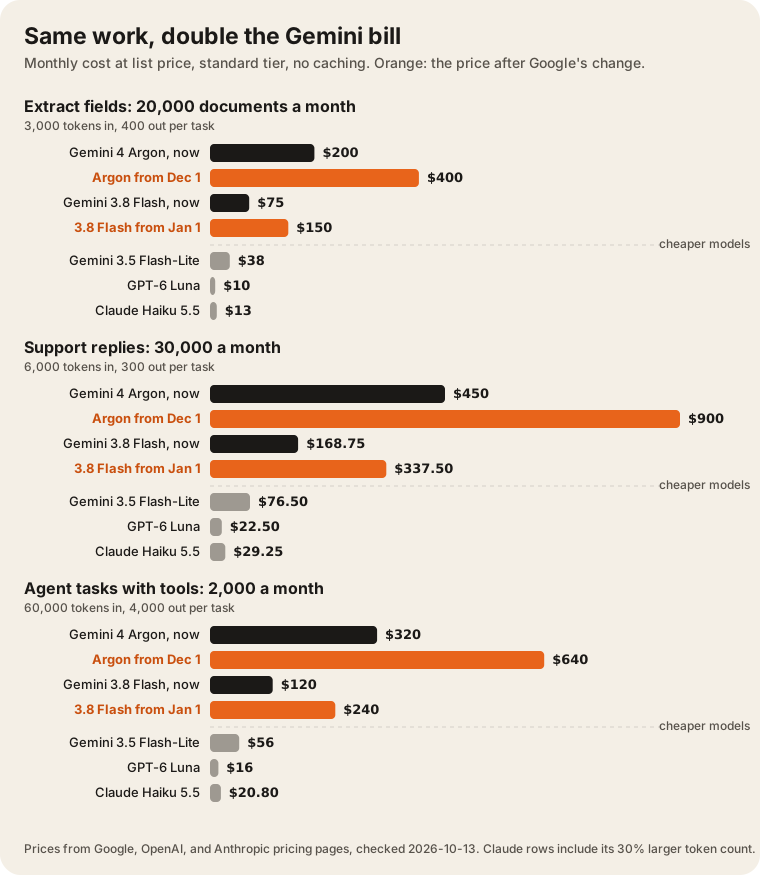
| Workload per month | Argon now | Argon from Dec 1 | 3.8 Flash now | 3.8 Flash from Jan 1 | Cheapest switches to test |
|---|---|---|---|---|---|
| Extract fields from 20,000 documents (3,000 tokens in, 400 out) | $200 | $400 | $75 | $150 | GPT-6 Luna $10, Claude Haiku 5.5 $13, Gemini 3.5 Flash-Lite $38 |
| 30,000 support replies (6,000 in, 300 out) | $450 | $900 | $168.75 | $337.50 | GPT-6 Luna $22.50, Haiku 5.5 $29.25, Flash-Lite $76.50 |
| 2,000 agent tasks with tools (60,000 in, 4,000 out) | $320 | $640 | $120 | $240 | GPT-6.1 Sol $320, Claude Sonnet 5.5 $416, Flash-Lite $56 |
Prices for the switches come from OpenAI’s pricing page and Anthropic’s pricing page, checked 2026-10-13. GPT-6 Luna and Claude Haiku 5.5 both list $0.10 input and $0.50 output.
The cheapest switch is not always the right one. A small model that gets 10% of invoices wrong costs more than the tokens it saves. For the agent workload we list same-tier models instead: after December 1, Argon’s $4 / $20 is twice GPT-6.1 Sol and Claude Sonnet 5.5 ($2 / $10), and equal to Claude Opus 5.5.
What to do before each date
- Find which Gemini models you call. Search your code and config for
gemini-. Anygemini-3.5-flashorgemini-3.7-flashcounts as 3.6 or 3.8 Flash for billing. - Re-price your plan on the new rates now. If you charge customers a monthly seat, a doubled model bill comes straight out of margin. Our AI SaaS margin calculator already has both the 2026 and 2027 Gemini 3.8 Flash rows, and both Argon rows.
- Test one cheaper model on your real inputs. Run 50 real requests through Gemini 3.5 Flash-Lite, GPT-6 Luna, or Claude Haiku 5.5 and compare the output with what you get today. Keep the one that still does the job.
- Move waiting work to Batch. Batch halves the input and output price on every model in the table, before and after the change. On Argon after December 1, Batch is $2 / $10, the same as today’s standard rate.
- Turn on caching where prompts repeat. On Argon, caching is implicit, so there is nothing to switch on, but a cache hit needs at least 4,096 tokens of identical prefix, per Google’s caching docs. Put fixed instructions first.
Why this is easy to miss
The two dates live in different places. Argon’s increase was in the launch news. VentureBeat’s launch story on October 13 covers the December 1 date but not the January 1 Flash change. A popular October pricing roundup lists the January Flash change but doesn’t name Argon at all. Both are on Google’s pricing page, in the price cells themselves.
We’ll update this page after December 1 and again after January 1, 2027. After that, the history moves into our AI API pricing comparison.
FAQ
Is the Gemini API getting more expensive?
Yes, for three models. Gemini 4 Argon doubles on December 1, 2026. Gemini 3.8 Flash and Gemini 3.6 Flash double on January 1, 2027. Flash-Lite and Gemini 3.1 Pro Preview have no change listed on Google’s pricing page as of 2026-10-13.
How much will Gemini 3.8 Flash cost in 2027?
$1.50 per million input tokens and $7.50 per million output tokens on the paid tier, from January 1, 2027. Cached input goes to $0.15, and Batch to $0.75 / $3.75.
Why is Gemini 4 Argon so cheap right now?
Google lists $2 / $10 as the price “through November 30, 2026.” Its release notes don’t give a reason. Treat the current price as a launch price and plan your costs on $4 / $20.
What is the cheapest alternative to Gemini Flash?
At list price, GPT-6 Luna and Claude Haiku 5.5 both cost $0.10 input and $0.50 output per million tokens, checked 2026-10-13. Inside Gemini, 3.5 Flash-Lite is $0.30 / $2.50. Which one is good enough depends on your task, so test on real inputs. Our cost per user calculator shows what each one costs per user per month.
Should I switch to usage-based billing because of this?
If your model costs can double on a date you don’t control, a usage allowance with overage protects you better than a flat “unlimited” plan. We compare the billing tools in usage-based billing for AI SaaS, and the pricing math in how to price an AI SaaS.
We test and switch models inside existing products as part of our AI integration work.