
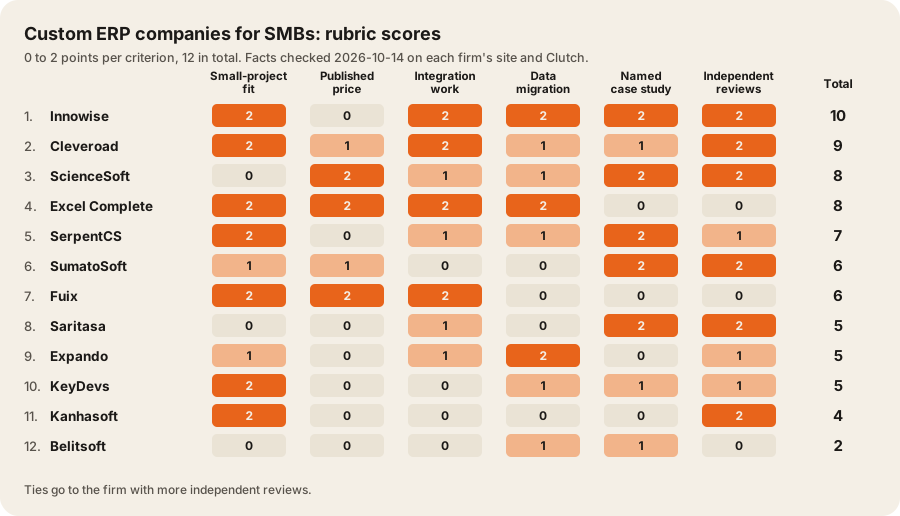
The custom ERP development company that scores best for a small or mid-size business on what it publishes is Innowise, with 10 of 12 points: a $10,000 minimum on Clutch, a named ERP case study that lists the accounting and banking systems it connected, and a data migration with validation checks. Cleveroad is second with 9, and has the longest list of named integrations, including QuickBooks and Xero.
We wrote this guide, so weigh that. We left ourselves out of the ranking. Where we fit is in a box at the end.
Who this is for: businesses with roughly 10 to 200 staff that want an ERP built around how they work, or a custom system that connects to the accounting app they already use. Who should look elsewhere: if your processes are standard, an off-the-shelf ERP such as Odoo is usually cheaper. Its pricing page offers a One App Free plan: “One app, unlimited users” (checked 2026-10-14). If you’re not sure you need an ERP at all, start with the signs your spreadsheet just became an ERP.
Most “custom ERP development company” results are vendors’ own service pages, or “top 10” lists written by a vendor that ranks itself first. Of the top five results we read on 2026-10-14, one was an ERP vendor’s page quoting module prices from $200,000, one ranked its own firm and its sister brand first and second, and one was a reseller page for a packaged ERP. None scored firms on what a small business needs to check. This list does, and links every fact to the firm’s own page or its Clutch profile.
How we scored them
A small business buying a custom ERP has three big risks: the firm only takes large projects, the system won’t talk to the accounting and sales tools already in use, and years of data get lost or mangled on the way in. So we scored what each firm publishes about those risks, plus what a buyer can check from outside.
Six criteria, 0 to 2 points each, 12 points in total. We only counted what the firm’s own site or its Clutch profile shows. A firm may do more than it publishes. We can’t see that, and neither can you before you ask.
| Criterion | 2 points | 1 point | 0 points |
|---|---|---|---|
| Small-project fit | Minimum or starting price of $20,000 or less | $25,000 to $49,999 | $50,000 or more, or nothing published |
| Published price | An ERP or project price range on the firm’s own site | A general software cost range on its own site | None |
| Integration work | Names accounting systems (QuickBooks, Xero, DATEV, and the like) on its ERP page or in a named project | Names other specific systems | Generic wording only |
| Data migration | Describes moving old data with validation or sign-off | Mentions data migration | Not found |
| Named case study | A named client on an ERP or back-office build | An anonymous ERP case, or a named project that isn’t an ERP | None found |
| Independent reviews | 15 or more reviews averaging 4.5+ on Clutch or GoodFirms | Fewer reviews there, or reviews on marketplaces tied to paid orders | None found |
For small-project fit we used the firm’s own ERP price when it publishes one, and its Clutch minimum otherwise. Ties go to the firm with more independent reviews. All facts were checked on 2026-10-14. GoodFirms blocked our checks that day, so review scores come from Clutch. Sites change, so open the links before you rely on one.
The list at a glance
| # | Company | Fit | Price | Integrations | Migration | Case study | Reviews | Total |
|---|---|---|---|---|---|---|---|---|
| 1 | Innowise | 2 | 0 | 2 | 2 | 2 | 2 | 10 |
| 2 | Cleveroad | 2 | 1 | 2 | 1 | 1 | 2 | 9 |
| 3 | ScienceSoft | 0 | 2 | 1 | 1 | 2 | 2 | 8 |
| 4 | Excel Complete | 2 | 2 | 2 | 2 | 0 | 0 | 8 |
| 5 | SerpentCS | 2 | 0 | 1 | 1 | 2 | 1 | 7 |
| 6 | SumatoSoft | 1 | 1 | 0 | 0 | 2 | 2 | 6 |
| 7 | Fuix | 2 | 2 | 2 | 0 | 0 | 0 | 6 |
| 8 | Saritasa | 0 | 0 | 1 | 0 | 2 | 2 | 5 |
| 9 | Expando | 1 | 0 | 1 | 2 | 0 | 1 | 5 |
| 10 | KeyDevs | 2 | 0 | 0 | 1 | 1 | 1 | 5 |
| 11 | Kanhasoft | 2 | 0 | 0 | 0 | 0 | 2 | 4 |
| 12 | Belitsoft | 0 | 0 | 0 | 1 | 1 | 0 | 2 |
The 12 companies
1. Innowise
- Small-project fit: Clutch lists a $10,000+ minimum and $50 to $99 an hour.
- Price: none on its site. Its contact form offers budgets from “Under $15K” up. Its custom ERP page gives timelines: “MVP development 2-3 months”.
- Integrations: its IS Engineering case study says “Accounting lived in DATEV”, and the team “set up the monthly DATEV export and EBICS reconciliation flow”. EBICS is a banking standard used in Germany.
- Migration: “decades of financial data, including customers, suppliers, inventory, products, BOMs, and orders, were migrated into Odoo’s database with validation checks to ensure consistency.”
- Case study: IS Engineering Monforts Walzentechnik, a named client in Germany. The build is on Odoo 17 Enterprise, so it’s a customised ERP rather than one written from scratch.
- Reviews: 4.9 from 73 reviews on Clutch.
- Where: Warsaw, Poland, per Clutch.
- Also: the ERP page has a section on “ERP software for small businesses”, “Tailored to fit small companies’ unique needs and budget constraints”.
- Best for: SMBs that want a large, well-reviewed team and are open to an Odoo-based build.
2. Cleveroad
- Small-project fit: Clutch lists $10,000+ and $25 to $49 an hour.
- Price: its blog puts ERP builds at “$50,000 to $250,000+” (how to build an ERP). That’s a general market range.
- Integrations: the longest list here. Its ERP page names Quickbooks, Xero, and MYOB AccountRight under finance, plus Shopify, Salesforce, NetSuite, and shipping tools.
- Migration: the blog says to “Plan data migration from day one”. The service page doesn’t describe a migration step.
- Case study: RetailOps, named, with a quote from its CTO. It’s a retail operations app with scanner and printer integrations, not an ERP, so it scores 1.
- Reviews: 4.9 from 81 reviews on Clutch.
- Where: New York, per Clutch, with offices in Estonia.
- Best for: businesses whose ERP has to connect to several named tools, especially QuickBooks or Xero.
3. ScienceSoft
- Small-project fit: its ERP page says a standalone module costs “from $200,000 to $500,000” and an all-in-one ERP “$1,500,000+”. That’s the zero. Clutch lists a $5,000+ minimum, but that covers all its work.
- Price: published, as above, which earns the 2.
- Integrations: names Salesforce, Microsoft Dynamics 365, and payment gateways such as Stripe and PayPal. No accounting app named.
- Migration: “Enterprise data migration from spreadsheets or a previously used resource planning system to ERP.”
- Case study: Give Back Wireless, named, for support of an existing ERP rather than a new build.
- Reviews: 4.8 from 43 reviews on Clutch.
- Where: McKinney, Texas.
- Best for: mid-size and larger firms with an enterprise budget. Not for small budgets, by its own published prices.
4. Excel Complete
- Small-project fit and price: “ERP development projects typically start at $20,000. Common projects include accounts payable systems, budgeting applications, inventory tracking systems, and spreadsheet replacements.” (ERP page)
- Integrations: “integrate QuickBooks, NetSuite, and payroll systems into a single platform”.
- Migration: “We develop and integrate the system, migrate and validate data, and support rollout and adoption.”
- Case study: none found.
- Reviews: we found no Clutch or GoodFirms profile.
- Where: Ann Arbor, Michigan.
- Also: “For small businesses, ERP work often takes the form of a focused custom web application that connects to an existing accounting or ERP platform such as NetSuite.”
- Best for: small US businesses that want a focused system next to QuickBooks or NetSuite, with a clear starting price. Ask for references, since there’s no public review record.
5. SerpentCS
- Small-project fit: Clutch lists $5,000+ and $25 to $49 an hour.
- Price: none. Its site offers “Free Consulting”.
- Integrations: lists Odoo integrations such as RingCentral and Temu. No accounting app, since Odoo has its own.
- Migration: its TruThread case “migrated several years of critical accounting and operational data from legacy Odoo v6.1 to Odoo v16.”
- Case study: TruThread Manufacturing, named.
- Reviews: 4.9 from 10 reviews on Clutch.
- Where: Gandhinagar, India.
- Best for: businesses already on Odoo, or ready to move to it, on a modest budget.
6. SumatoSoft
- Small-project fit: Clutch lists $25,000+ and $50 to $99 an hour.
- Price: its cost calculator page gives general ranges: an MVP at $20,000 to $50,000, and a mid-size product at $100,000 to $200,000. Not ERP-specific.
- Integrations: none named on the case below.
- Migration: not described.
- Case study: ScaLex, built for the named Business Car Group, a Toyota and Lexus dealer network. “One unified platform replaced multiple systems”.
- Reviews: 4.8 from 25 reviews on Clutch.
- Where: Boston, Massachusetts.
- Best for: mid-size firms with a $25,000+ budget. Ask how they handle integrations and data migration.
7. Fuix
- Small-project fit and price: its custom software page lists a “Contained project” at 8,000 to 20,000 USD, a “Mid-sized project” at 20,000 to 40,000, and a “Complex project” at 40,000 to 90,000+. The page calls these market reference bands.
- Integrations: “Non-intrusive APIs over Manager, SAP Business One, Defontana or your current build”. Manager and Defontana are accounting and ERP products.
- Migration: not described.
- Case study: none found.
- Reviews: we found no Clutch or GoodFirms profile.
- Where: Santiago, Chile, working US hours.
- Best for: SMBs that want to extend an ERP they already have, with a price range up front. The missing case studies and reviews are the weak point.
8. Saritasa
- Small-project fit: Clutch lists $50,000+ and $100 to $149 an hour, the highest here.
- Price: none on its site. Its ERP page says many builds “take anywhere from 3 to 12 months”.
- Integrations: “CRM systems like Salesforce, e-commerce platforms like Shopify, or legacy manufacturing tools”.
- Migration: not described. “Legacy ERP modernization” is listed as a service.
- Case study: Cummins Pacific, named. Saritasa “integrated the platform with their legacy ERP system”.
- Reviews: 4.8 from 108 reviews on Clutch, the most of any firm here.
- Where: Irvine, California.
- Best for: US mid-market firms that want a US team and have the budget. Not for small budgets.
9. Expando
- Small-project fit: Clutch lists $25,000+ and $25 to $49 an hour.
- Price: none. It offers “Fixed-scope, fixed-price proposals” (ERP page).
- Integrations: “We integrate Odoo with Shopify, WooCommerce, and custom platforms”, plus payment gateways such as Stripe and PayFast.
- Migration: “clean import of existing customer, supplier, product, and financial data”, with bank transactions and opening balances “verified by your finance team”.
- Case study: none named.
- Reviews: 4.7 from 5 reviews on Clutch.
- Where: Karachi, Pakistan.
- Also: “We’ve implemented for businesses as small as 8 staff and as large as 200.”
- Best for: small Odoo projects where a careful finance migration matters most.
10. KeyDevs
- Small-project fit: Clutch lists $5,000+ and $25 to $49 an hour.
- Price: none. Its form offers budget bands in pounds.
- Integrations: none named on its ERP page.
- Migration: a general line: “Move over old manual data feeding”.
- Case study: a testimonial from AtlasFuel Australia about “our ERP system”, with no case study page.
- Reviews: 5.0 from 1 review on Clutch. Its site shows a higher count, which we couldn’t match on Clutch.
- Where: Lahore per its site, Islamabad per Clutch.
- Best for: very small budgets. Ask for references and a written scope.
11. Kanhasoft
- Small-project fit: Clutch lists $5,000+ and under $25 an hour.
- Price, integrations, migration: its site blocked every check we ran on 2026-10-14, so these are not confirmed on the official page and score 0.
- Case study: none we could read.
- Reviews: 5.0 from 22 reviews on Clutch. One review there, from Secro Inc, says the team was “developing the entire ERP system from scratch”.
- Where: Ahmedabad, India.
- Best for: the lowest hourly rates on this list. Ask for the details its site wouldn’t show us.
12. Belitsoft
- Small-project fit: not found. We couldn’t open a Clutch profile, and GoodFirms blocked our checks.
- Price: none. Its ERP page lists “Time and Material, Fixed price, Cost+” as models.
- Integrations: generic: “CRM, a vendor portal, IoT control systems”.
- Migration: “Enterprise data migration from spreadsheets or a previously used resource planning system to ERP.”
- Case study: anonymous cases only.
- Reviews: none we could confirm.
- Best for: buyers who already know the firm. There’s too little public proof to judge it from outside.
Checked and left off
- Kanhasoft’s own ERP page and Space-O Technologies refused our checks. Kanhasoft stays on the list on its Clutch record. Space-O had no Clutch profile we could open, so we left it off.
- Folio3 focuses on NetSuite rather than custom ERP.
- Watkyn ranked for the search, but the page is about implementing a packaged ERP (Acumatica), not custom builds.
If you run a custom ERP firm and publish this kind of detail, send us the links and we’ll score you by the same rules.
What the scores say
- Prices are rare, and the published ones split two ways. ScienceSoft publishes six- and seven-figure module prices. Excel Complete and Fuix publish ranges a small business can plan around. Most firms ask you to talk first.
- Integration proof is thin. Only Innowise, Cleveroad, Excel Complete, and Fuix name accounting systems. If your ERP has to talk to QuickBooks or Xero, ask every firm for a project where it did. Our guide to QuickBooks and Xero integration for custom software lists the questions that matter.
- Migration is a line item, not a plan, for most. Innowise, Excel Complete, and Expando describe checking the data on the way in. Ask everyone else how they’ll prove nothing was lost.
Before you sign, run any quote through our software quote checker, and read how to vet an offshore development team before you send money.
Where Dawloom fits
We build custom operations systems that connect to the tools a business already uses. Our client FurnitureAxis, a US furniture retailer, runs on a platform we built with serialized inventory, purchase orders, delivery scheduling, a QuickBooks accounting integration, and Shopify storefront sync. Our ERP and operations page plans data migration as its own workstream, with test runs.
We bill $30 an hour, or by milestone, from a written scope (pricing). We don’t publish a minimum project size or a project price. We have no Clutch or GoodFirms profile. Our reviews are 4.9 from 343 on Fiverr and 5.0 from 156 on Freelancer.com, under our founder’s name, and many are for smaller jobs than an ERP.
Pick someone else if you want a published price before you talk to anyone (Excel Complete or Fuix), Clutch reviews (Innowise or Cleveroad), an Odoo-based build (Innowise, SerpentCS, or Expando), or a large vendor for an enterprise rollout (ScienceSoft). If your project fits us, tell us what you’re building and we’ll send a written scope before any number.
FAQ
How much does a custom ERP cost for a small business?
Published starting points on this list range from $5,000 Clutch minimums to ScienceSoft’s “$200,000 to $500,000” per module. Excel Complete says its ERP projects “typically start at $20,000”, and Fuix lists contained projects at 8,000 to 20,000 USD (checked 2026-10-14). A focused system next to your existing accounting app costs far less than a full ERP.
Custom ERP or off-the-shelf like Odoo?
Off-the-shelf wins when your processes are standard, such as invoicing, stock, and payroll. Custom wins when your workflow is unusual, when you need tight links to tools you already use, or when per-user fees would keep growing. Several firms here, like Innowise, SerpentCS, and Expando, customise Odoo, which sits in between. If Odoo doesn’t fit your workflow, see Odoo alternatives, and when an app beside Odoo is enough.
How long does custom ERP development take?
Saritasa says many of its custom ERPs “take anywhere from 3 to 12 months”, and Innowise quotes “2-3 months” for an MVP. Starting with one or two modules gets something working sooner.
What should I ask a custom ERP company before hiring?
Ask for a named project that connected to your accounting app, how they’ll migrate and check your old data, who owns the code, and what the minimum project size is. Then compare their answers to what they publish.